
Oura vs. Whoop for Seniors: Which Tracker Provides Better Sleep Data?
Transparency Note: We use affiliate links on this page. If you decide to buy something through these links, we may earn a small commission. This helps us keep the site running and provides you with free content. Thank you for the support!
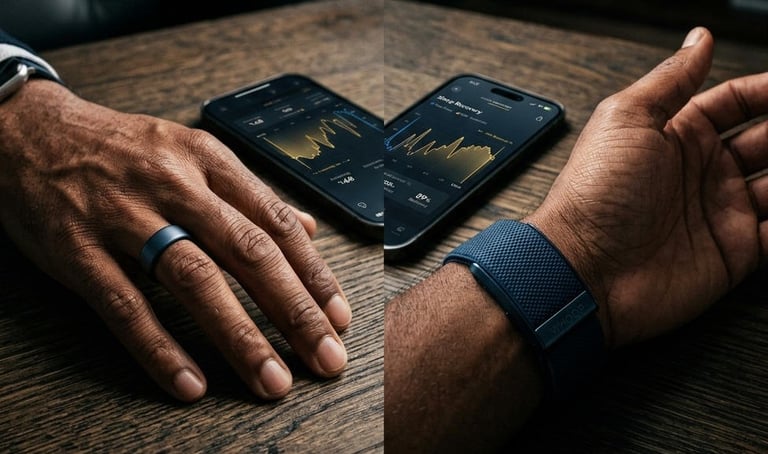
In the era of Medicine 2.0, sleep was often treated as a passive state—a "black box" of downtime that we hoped would be sufficient. If you woke up tired, you drank more coffee. If you couldn't sleep, you were prescribed a sedative. At EvergoldLongevity, we recognize that this approach is fundamentally flawed. Sleep is the most active, metabolically intense "repair cycle" of the human experience. It is where Biological Capital is minted.
For the modern senior, tracking this repair cycle is a non-negotiable part of a longevity strategy. But the market is flooded with devices. Two names dominate the conversation: the Oura Ring and the Whoop Strap. Both claim to be the gold standard, but for the 60+ professional, the "best" tracker isn't necessarily the one with the most features—it’s the one that provides the most actionable, context-rich data for a maturing physiology.
1. The Wearable as a "Digital Twin"
Before we dive into the hardware, we must establish the "Medicine 3.0" goal. We are not just looking for a "Sleep Score." We are looking for a Digital Twin—a longitudinal record of your biomarkers that can predict illness, measure recovery from exercise, and audit the impact of your evening wine or late-night blue light exposure.
Both Oura and Whoop use Photoplethysmography (PPG)—the use of light to measure blood flow—to track:
Heart Rate Variability (HRV): The variation in time between each heartbeat, a primary marker of nervous system health.
Resting Heart Rate (RHR): A foundational indicator of cardiovascular efficiency.
Respiratory Rate: A critical "early warning" metric for respiratory infection.
Sleep Stages: The breakdown of Light, Deep, and REM sleep.
2. Oura Ring Gen3: The Discreet Sleep Specialist
The Oura Ring has long been the darling of the "Sleep First" community. Its form factor—a sleek, titanium ring—is its greatest strength and perhaps its most significant limitation.
The Accuracy of the Finger
In the Medicine 3.0 world, sensor placement matters. The arteries in your fingers are much closer to the surface than the arteries in your wrist. This allows Oura to get an incredibly clean signal for HRV and RHR. For seniors, who may have thinner skin or reduced peripheral circulation, the finger is often a more reliable "data port" than the wrist.
The Oura Philosophy: "Readiness"
Oura is built around the concept of a Readiness Score. It looks at your previous night's sleep, your activity levels, and your body temperature to tell you how hard you should push yourself today.
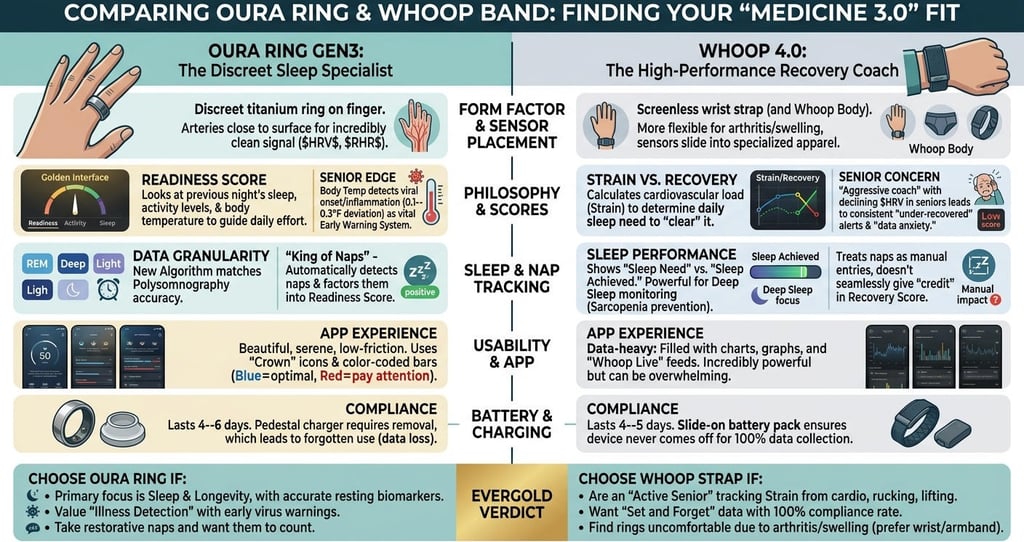
The Senior Edge: Oura’s focus on Body Temperature is a standout feature. It can detect a 0.1-0.3° deviation from your baseline, often flagging a viral onset or an inflammatory response days before you feel a single symptom. For a population where immune resilience is a priority, this is a vital "Early Warning System."
3. Whoop 4.0: The High-Performance Recovery Coach
Whoop was originally designed for elite athletes—Olympic weightlifters and NFL players. However, its focus on "Strain" and "Recovery" has made it a powerful tool for the "Evergold Athlete" who is serious about Zone 2 training and Rucking.
Form Factor: The Wrist (and Beyond)
Whoop is a screenless strap. It doesn't have a clock or notifications. Its goal is to be invisible.
The Senior Edge: While the wrist is the default, Whoop offers "Whoop Body," which allows you to slide the sensor into specialized underwear or armbands. For those who find wearing a ring uncomfortable due to arthritis or "finger swelling," the Whoop provides a more flexible wearability profile.
The Whoop Philosophy: "Strain vs. Recovery"
Whoop calculates how much "Strain" (cardiovascular load) you take on during the day and tells you exactly how much sleep you need to "clear" that strain.
The Problem for Seniors: Whoop is an "aggressive" coach. It prioritizes HRV above almost all other metrics. Because HRV naturally declines with age, many seniors find that Whoop consistently tells them they are "under-recovered," even when they feel great. This can lead to "data anxiety," which ironically disrupts the very sleep you are trying to track.
4. The Sleep Duel: Data Granularity
When we look specifically at sleep data, the two devices take different approaches to the same night.
Sleep Stages: REM and Deep Sleep
Both devices attempt to track REM (cognitive repair) and Deep Sleep (physical repair).
Oura: Historically, Oura has been criticized for being slightly too "generous" with its sleep stage estimates. However, with the rollout of their new "Sleeptracking Algorithm," their accuracy has moved closer to Polysomnography (PSG)—the clinical gold standard.
Whoop: Whoop provides a "Sleep Performance" percentage. It tells you your "Sleep Need" versus your "Sleep Achieved." For a senior focused on Sarcopenia prevention, seeing that you missed 45 minutes of Deep Sleep is a powerful motivator to fix your evening "Sleep Hygiene."
The Nap Factor
This is a critical distinction for the retired or semi-retired professional.
Oura: Oura is the king of naps. It detects them automatically, asks you how you feel, and—crucially—factors that nap into your Readiness Score for the next day.
Whoop: Whoop treats naps as "manual entries." It doesn't "give you credit" for a nap in your recovery score in the same seamless way Oura does. If your "Medicine 3.0" protocol includes a 20-minute restorative afternoon nap, Oura is the superior auditor.
5. Usability and "The Golden Interface"
Data is only useful if you can understand it at 7:00 AM without a PhD in Biostatistics.
The App Experience
Oura: The Oura app is beautiful, serene, and "low-friction." It uses simple "Crown" icons and color-coded bars (Blue for optimal, Red for pay attention). It feels like a high-end wellness concierge.
Whoop: The Whoop app is a "data-heavy" environment. It is filled with charts, graphs, and "Whoop Live" feeds. It is incredibly powerful but can be overwhelming for someone who just wants to know if they should go for a long walk or take a rest day.
Battery and Charging
Oura: Lasts about 4–6 days. You have to take it off to charge it on a small pedestal. This is the #1 reason people lose their data—they forget to put the ring back on after charging.
Whoop: Lasts about 4–5 days. Whoop has a "Slide-on" battery pack, meaning you never have to take the device off. This ensures a 100% "compliance rate," which is essential for accurate longitudinal data.
6. The "Evergold" Verdict: Which is for You?
Choosing between Oura and Whoop depends on your "Medicine 3.0" archetype.
Choose the Oura Ring if:
Your primary focus is Sleep and Longevity. You want the most accurate resting biomarkers (HRV and Temp) and a discreet, elegant form factor.
You value "Illness Detection." You want a device that warns you 48 hours before you get the flu.
You take naps. You want your daytime rest to count toward your daily score.
Choose the Whoop Strap if:
You are an "Active Senior." You are doing Zone 2 cardio, Rucking, or lifting weights 4+ days a week, and want to know if you are overtraining.
You want "Set and Forget." You never want to take the device off and want 24/7 data without fail.
You find rings uncomfortable. If arthritis makes ring-wearing difficult, the wrist/armband flexibility of Whoop is superior.
6. The "Evergold" Verdict: Which is for You?
Choosing between Oura and Whoop depends on your "Medicine 3.0" archetype.
Choose the Oura Ring if:
Your primary focus is Sleep and Longevity. You want the most accurate resting biomarkers (HRV and Temp) and a discreet, elegant form factor.
You value "Illness Detection." You want a device that warns you 48 hours before you get the flu.
You take naps. You want your daytime rest to count toward your daily score.
Choose the Whoop Strap if:
You are an "Active Senior." You are doing Zone 2 cardio, Rucking, or lifting weights 4+ days a week, and want to know if you are overtraining.
You want "Set and Forget." You never want to take the device off and want 24/7 data without fail.
You find rings uncomfortable. If arthritis makes ring-wearing difficult, the wrist/armband flexibility of Whoop is superior.
7. A Warning on "Data Obsession"
In the world of EvergoldLongevity, we remind our athletes that "The map is not the territory." If you wake up feeling like a million dollars, but your Oura ring gives you a "Readiness Score" of 62, trust your body. Wearables are tools for trend-tracking, not absolute truths. Use them to identify what ruins your sleep (alcohol, late-night meals, heat) and what optimizes it (morning sun, cold rooms, magnesium).
Conclusion: Investing in Your Ocular Hardware
Whether you choose the ring or the strap, you are making a profound investment in your Biological Capital. You are moving from "guessing" how you feel to "knowing" how your body is responding to the stress of life and the aging process.
In the Medicine 3.0 era, the person with the best data usually wins the game of longevity. Pick your sensor, start your audit, and own your recovery.
Stay Strong. Stay Data-Driven. Stay Evergold.
Contact
© 2026. All rights reserved.
DISCLAIMER
We love sharing information, but please remember we aren't doctors, lawyers, or financial advisors. Always check in with a professional before you start a new fitness routine, change your diet, or make big financial decisions. Your specific situation deserves expert attention.