
Resistance Bands vs. Free Weights for Seniors
Transparency Note: We use affiliate links on this page. If you decide to buy something through these links, we may earn a small commission. This helps us keep the site running and provides you with free content. Thank you for the support!
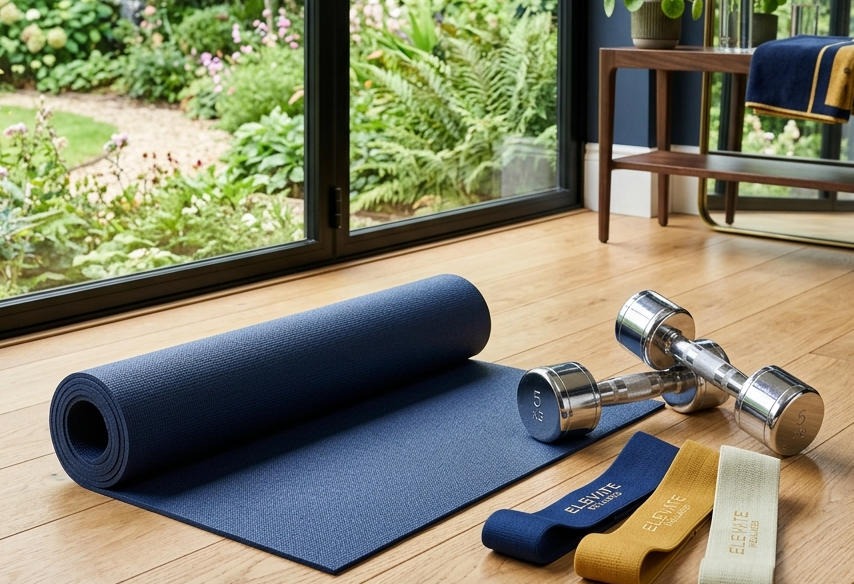
In the Evergold philosophy, we treat muscle mass as a high-yield retirement account. You spend your youth making deposits so that in your "Marginal Decade"—the final ten years of your life—you have enough "physical capital" to remain independent, mobile, and vibrant.
However, as we move into the world of Medicine 3.0, the question isn't if we should train, but how. When you walk into a gym or look at your home setup, you are faced with a fundamental choice: the iron (free weights) or the rubber (resistance bands).
For the 60+ athlete, this isn't just a matter of preference. It’s a matter of physics, joint preservation, and neurological signaling. Today, we are stripping away the marketing fluff to look at the cold, hard science of resistance. Whether you are fighting back against Sarcopenia (muscle loss) or Osteoporosis (bone loss), the tool you choose matters.
1. The Physics of the Pull: Gravity vs. Elasticity
To understand which tool is better, we have to look at the math of how they challenge your muscles.
Free Weights: The Constant Load
Free weights (dumbbells, kettlebells, barbells) rely on gravity. The resistance they provide is isotonic and constant. If you hold a 10lb dumbbell, it weighs 10lbs at the bottom of the movement and 10lbs at the top.
The force (F) exerted by a free weight is calculated by:
F = m x g
Where m is the mass of the weight and g is the acceleration due to gravity (9.8 m / s^2).
Because gravity only pulls downward, the "challenge" to your muscle changes based on your joint angle (leverage). This creates a "sticking point"—the hardest part of the lift.
Resistance Bands: The Variable Load
Bands operate on Hooke’s Law. The resistance is not constant; it is a linear variable resistance. The further you stretch the band, the harder it fights back.
The force (F) exerted by a band is:
F = k x X
Where k is the spring constant (the stiffness of the band) and X is the distance the band is stretched.
The Evergold Insight: With bands, the exercise is easiest where you are weakest (the start) and hardest where you are strongest (the finish). This "ascending resistance profile" often matches the natural strength curve of human joints, making them feel "smoother."
2. Bone Density: The Case for Heavy Iron
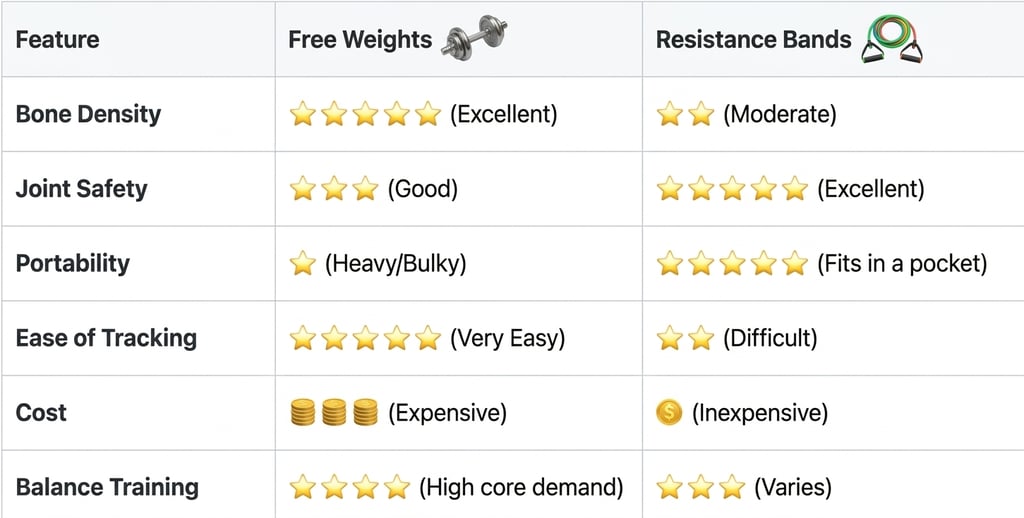
If your primary goal is the prevention of osteoporosis, Free Weights have a distinct advantage.
Bone is living tissue that responds to stress through a process called Wolff’s Law. To signal the body to lay down new bone mineral, you need axial loading—pressure that travels through the long axis of the bone.
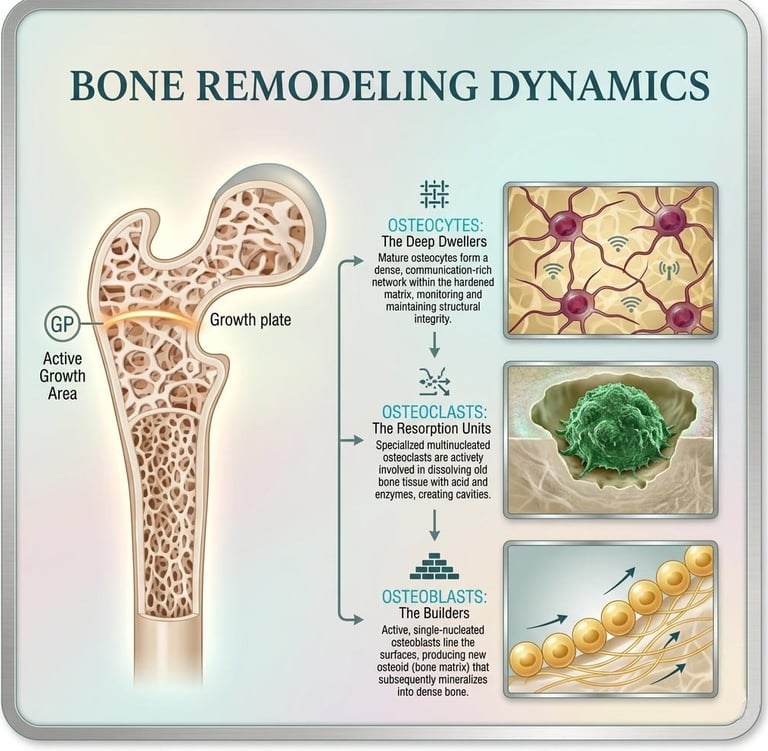
Free Weights: Carrying a pair of dumbbells or placing a bar across your shoulders provides a compressive force that "wakes up" your osteoblasts (bone-building cells).
Bands: While bands provide excellent muscle tension, they offer very little in terms of compressive, axial loading. You cannot "load" your skeleton with a rubber band in the same way you can with a kettlebell.
The Medicine 3.0 Verdict: If you have been diagnosed with osteopenia or osteoporosis, free weights should be the "primary" in your program.
3. Joint Safety and the "Ego" Factor
As we age, our tendons and ligaments lose some of their elasticity. We have to be more calculated with how we apply stress.
Why Bands Win on Safety
Lower Initial Momentum: With free weights, it's easy to use "momentum" to swing the weight, which puts a high-velocity snap on the tendons. Bands require a controlled, deliberate pull; you cannot "swing" a band effectively.
Deceleration Control: Bands force you to control the "eccentric" (lowering) phase of the movement. If you let go, it snaps back. This constant tension improves proprioception—your brain’s ability to know where your limbs are in space.
Joint-Friendly Angles: Free weights force you to follow a path dictated by gravity. Bands allow for a "free-form" path of motion. If your shoulder feels "pinched" during a press, you can slightly shift your hand position with a band to find a pain-free path.
Why Weights Can Be Riskier
The biggest risk with free weights for seniors is the "Drop Risk." A dropped 20lb dumbbell can break a foot or damage a floor. A "dropped" resistance band simply goes limp.
4. Hypertrophy: Building the "Engine"
When it comes to building raw muscle size (hypertrophy), both tools can work, but weights are more "trackable."
In the Evergold protocol, we prioritize Progressive Overload. To grow, you must lift more this month than you did last month.
Weights: It is easy to see progress. You moved from the 10lb dumbbells to the 12lb dumbbells. That is a measurable 20% increase.
Bands: Progress is "fuzzy." How far did you stretch it? Was the band older and more "stretched out" today? This lack of precision can make it harder for seniors to ensure they are actually challenging their muscles enough to flip the mTOR switch for growth.
5. The Comparison Table: At a Glance
6. The "Evergold" Hybrid Approach
We don't believe in "either/or." We believe in The Right Tool for the Right Task. For a resilient Marginal Decade, we recommend a 70/30 Split:
The 70% (The Iron Foundation)
Twice a week, use Free Weights for your "Big Compound" movements:
Goblet Squats: To load the hips and spine for bone density.
Deadlifts: To build the "armor" of the back.
Overhead Presses: To maintain shoulder strength.
The 30% (The Band Polish)
Use Resistance Bands for "Accessory" and "High-Rep" work:
Face Pulls: To fix "Senior Slump" and improve posture.
Lateral Walks: To strengthen the glute medius and improve balance.
Travel: When you are away from home, a set of bands ensures you never miss a "deposit" in your muscle account.
Conclusion: Don't Be Afraid of the Load
Whether you choose the iron or the rubber, the most important thing is that you challenge your current capacity. The greatest risk to a 70-year-old isn't the weight they do lift; it's the weight they don't. Sarcopenia is a silent thief. Resistance training is the only way to lock the door.
If you prefer the portability and joint-comfort of bands, use them with intensity. If you prefer the solid, measurable feel of iron, lift with precision. Just remember: Your body doesn't know the difference between a dumbbell and a piece of rubber; it only knows tension. Give it enough tension, and it will stay young.
Contact
© 2026. All rights reserved.
DISCLAIMER
We love sharing information, but please remember we aren't doctors, lawyers, or financial advisors. Always check in with a professional before you start a new fitness routine, change your diet, or make big financial decisions. Your specific situation deserves expert attention.