
Rucking for Seniors: The Low-Impact Secret to Building Cardio and Bone Density
We believe in building "Biological Capital" through strategic, safe, and progressive stress. And there is perhaps no tool more effective for building that capital than Rucking.
Evergold Longevity
3/27/20265 min read
Transparency Note: We use affiliate links on this page. If you decide to buy something through these links, we may earn a small commission. This helps us keep the site running and provides you with free content. Thank you for the support!
In the traditional medical paradigm (Medicine 2.0), the advice given to those over 60 regarding exercise is often defined by what not to do. "Don't lift too heavy," "don't run on hard surfaces," and "be careful not to fall." While this advice aims to prevent immediate injury, it inadvertently accelerates the very decline it seeks to avoid. By avoiding "load," we tell our bones they no longer need to be dense. By avoiding "intensity," we tell our hearts they no longer need to be powerful.
At EvergoldLongevity, we advocate for a different approach: Medicine 3.0. We believe in building "Biological Capital" through strategic, safe, and progressive stress. And there is perhaps no tool more effective for building that capital than Rucking.
1. What is Rucking? (From the Battlefield to the Boardwalk)
Rucking is a term derived from "rucksack," the weighted backpacks carried by infantry soldiers. In a military context, it is a test of grit and endurance. In a longevity context, it is the "Swiss Army Knife" of exercise.
Simply put, rucking is walking with weight. It bridges the gap between pure cardiovascular training (walking/running) and pure resistance training (weightlifting). For the 60+ professional, rucking provides the benefits of a jog with the impact of a walk, while simultaneously stimulating bone growth in a way that unweighted movement simply cannot.
2. The Cardio Pillar: Boosting VO2 max Without the Jarring
One of the greatest challenges in your "Second Act" is maintaining cardiorespiratory fitness without damaging the joints. Running, while effective for the heart, carries a high "orthopedic cost." Each step in a run sends a force of 2.5-3x your body weight through your knees and ankles.
Rucking changes the math.
The Metabolic Cost: Adding just 10% of your body weight to a backpack increases your caloric burn and heart rate by 20-30% compared to unweighted walking.
Zone 2 Training: Rucking is the "cheat code" for staying in Zone 2—the steady-state heart rate zone where you maximize mitochondrial efficiency and fat oxidation. For many seniors, walking is too easy to reach Zone 2, but running is too intense (pushing them into Zone 3 or 4). Rucking keeps you perfectly in the "sweet spot" of aerobic base building.
VO2 max: By increasing the oxygen demand on your muscles, rucking helps preserve and even increase your VO2 max, which is the single most important predictor of how many years you have left to live.
3. The Bone Density Pillar: Invoking Wolff’s Law
Osteopenia and Osteoporosis are silent thieves of independence. As we age, our bone mineral density (BMD) naturally declines—unless we give the body a reason to keep it.
The primary mechanism for building bone is Wolff’s Law, which states that bone grows and remodels in response to the forces placed upon it.
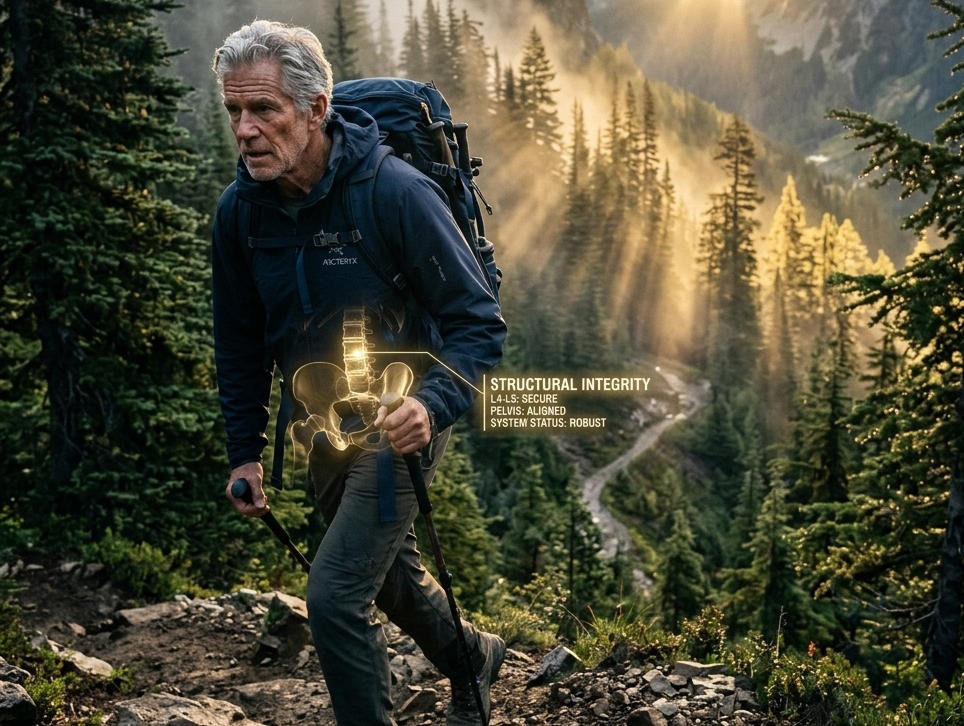
Axial Loading: When you put a ruck on your shoulders, you are providing "axial loading" through the spine and hips. This mechanical stress signals osteoblasts (bone-building cells) to lay down new mineral matrix.
The Hip and Spine Connection: These are the two most common sites for age-related fractures. Rucking specifically targets the density of the femoral neck (hip) and the lumbar vertebrae (spine), creating a "structural armor" that protects you against the consequences of a fall.
4. Postural Correction: The Antidote to "The Slouch"
Modern life—and the natural aging process—tends to pull our posture forward. We spend hours at desks and on phones, leading to "Kyphosis" (the rounded upper back) and a forward-leaning head.
Rucking is a corrective exercise for your posture.
The Weighted Stretch: The straps of a rucksack naturally pull your shoulders back into a more neutral, upright position.
Core Stability: To keep from being pulled backward by the weight, your deep core stabilizers (the transverse abdominis and multifidus) must engage constantly.
The Result: You don't just "do" rucking; you "wear" it. Over time, this trains your nervous system to maintain an upright, dignified, and powerful posture even when the ruck is off.
5. The Functional "Save": Training for Real Life
In Medicine 3.0, we train for the Centenarian Decathlon. One of the key events in that decathlon is the ability to carry your own groceries, lift a suitcase into an overhead bin, or carry a grandchild through a park.
Rucking is the ultimate functional trainer. It builds "Work Capacity." It ensures that a trip to the airport or a day of hiking isn't a "peak effort" that leaves you exhausted, but a "baseline effort" that you handle with ease. It builds the "posterior chain"—the glutes, hamstrings, and lower back—which are the muscles that keep you steady and prevent the "stumble" from becoming a "fall."
6. Gear: How to Ruck Like a Pro
For the Evergold Athlete, we recommend a professional approach to gear to minimize the risk of chafing or joint strain.
The Pack
While a standard backpack works for beginners, a dedicated rucking pack (like those from GORUCK or similar premium brands) is superior. These packs are designed to hold the weight high and close to the spine, which is safer for the lower back.
The Weight
Avoid using loose dumbbells or rocks, which can shift and create "hot spots" of pressure. We recommend Ruck Plates—flat iron weights designed to slide into a specific sleeve in the pack.
Alternative: A weighted vest is an excellent option for those who find shoulder straps uncomfortable. It distributes the weight more evenly around the torso.
The Shoes
Do not ruck in flimsy "minimalist" shoes. You are carrying extra load; your feet need support. Look for a high-quality "rucking boot" or a structured trail running shoe with a wide toe box to allow for natural foot splay.
7. The Evergold Protocol: Starting Safely
The most common mistake in rucking is starting too heavy, too fast. Follow this tiered approach to build your "Biological Capital" without overspending it.
Phase 1: The "10% Rule" (Weeks 1-4)
The Load: Start with 10% of your body weight. If you weigh 180 lbs, start with 15–20 lbs.
The Frequency: 1–2 times per week.
The Distance: 20–30 minutes on flat terrain.
The Goal: Focus on "Perfect Posture." Shoulders back, chin tucked, core engaged.
Phase 2: The "Load & Terrain" (Weeks 5-12)
The Load: Increase to 15% of your body weight.
The Frequency: 2–3 times per week.
The Terrain: Introduce gentle hills or uneven park paths. This further challenges your balance and ankle stability.
The Goal: Reach a cadence where you are slightly breathless but can still speak in short sentences.
Phase 3: The "Evergold Athlete" (Maintenance)
The Load: Cap your weight at 20% of your body weight. For longevity, there is rarely a need to go heavier, as the risk to the joints begins to outweigh the metabolic benefit.
The Goal: Use rucking as your primary Zone 2 tool. Aim for one 60-minute "Long Ruck" per week.
8. Safety and "The Red Zone"
While rucking is low-impact, it is not "no-impact."
The Knee Check: if you have existing Stage 4 osteoarthritis in the knees, consult your physician. However, for most, the muscle built around the knee during rucking actually reduces pain by providing better joint support.
The Spine: If you feel sharp, radiating pain in your lower back, your weight is too low in the pack or too heavy for your current core strength.
Conclusion: Carry Your Own Weight
Rucking is a metaphor for the Evergold life. It is the refusal to let go of your capability. By choosing to "carry the load" now, you ensure that you won't have to be "carried" later.
It is a simple, primal, and incredibly effective way to tell your heart to stay strong, your bones to stay dense, and your mind to stay resilient. Grab your pack, head outside, and start building the frame that will carry you through your next thirty years.
Stay Strong. Stay Flexible. Stay Evergold.
Contact
© 2026. All rights reserved.
DISCLAIMER
We love sharing information, but please remember we aren't doctors, lawyers, or financial advisors. Always check in with a professional before you start a new fitness routine, change your diet, or make big financial decisions. Your specific situation deserves expert attention.