
The Circadian Rhythm Reset: How Morning Sunlight Changes Your Brain
Your internal clock is the most powerful lever you have for building Biological Capital. It dictates the timing of your hormones, the efficiency of your metabolism, and the clarity of your cognition. And while there are many ways to influence this clock, none are as potent as the arrival of photons on your retina
Evergold Longevity
4/1/20265 min read

Transparency Note: We use affiliate links on this page. If you decide to buy something through these links, we may earn a small commission. This helps us keep the site running and provides you with free content. Thank you for the support!
In the outdated model of healthy aging (Medicine 2.0), sleep and energy were often viewed as secondary symptoms of lifestyle. If you couldn't sleep, you were given a sedative; if you lacked energy, you were told to drink more caffeine. These reactive measures address the symptoms while ignoring the fundamental master controller of human biology: the Circadian Rhythm.
At EvergoldLongevity, we recognize that your internal clock is the most powerful lever you have for building Biological Capital. It dictates the timing of your hormones, the efficiency of your metabolism, and the clarity of your cognition. And while there are many ways to influence this clock, none are as potent—or as scientifically vital—as the arrival of photons on your retina within the first hour of waking.
To stay sharp and resilient in your "Second Act," you must stop viewing the sun as a backdrop and start viewing it as a biological signal.
1. The Suprachiasmatic Nucleus: The Master Clock
Every cell in your body has a "clock" gene, but these trillions of individual timers require a conductor. That conductor is the Suprachiasmatic Nucleus (SCN), a tiny cluster of about 20,000 neurons located in the hypothalamus, directly above where the optic nerves cross.
The SCN does not "see" images; it "sees" time. It interprets the quality and quantity of light to determine where you are in the 24-hour cycle. When you view morning sunlight, you are effectively "setting" the SCN, which then sends a cascading signal to every organ system in the body, telling them to begin their daytime functions.
2. The Melanopsin Connection: Why Windows Aren't Enough
The eyes contain specialized cells called Intrinsically Photosensitive Retinal Ganglion Cells (ipRGCs). These cells contain a photopigment called Melanopsin, which is particularly sensitive to the short-wavelength "blue" light that is abundant in the morning sky.
However, there is a critical "Medicine 3.0" nuance that many overlook: Glass filters out the exact wavelengths you need.
The Window Problem: Standard window glass can filter out up to 50% of the light intensity and specifically blocks certain wavelengths that trigger the SCN.
The Intensity Gap: On a clear day, outdoor light can provide 10,000 to 100,000 lux (a measure of brightness). Inside a well-lit office or kitchen, you are lucky to get 500 lux.
To reset your brain, you must be outside. Even on a cloudy day, the lux levels outdoors are orders of magnitude higher than the brightest indoor lighting. At EvergoldLongevity, we emphasize that "Photons are the currency of energy." If you don't collect them early, your biological bank account remains empty for the day.
3. The Hormonal Cascade: Cortisol and Serotonin
The moment morning light hits your eyes, it triggers two essential hormonal shifts that define your daily performance.
I. The Cortisol Awakening Response (CAR)
In a healthy, optimized system, cortisol should "spike" about 30 to 45 minutes after waking. This is not the "stress" cortisol we fear; this is the Healthy Awakening Response. This spike sets a timer for your metabolic rate, immune function, and—most importantly—it sets the timer for when you will feel tired 16 hours later.
II. The Serotonin-Melatonin Bridge
Morning light stimulates the production of Serotonin, the neurotransmitter responsible for mood, focus, and "calm alertness."
The Secret: Serotonin is the direct chemical precursor to Melatonin. By getting bright light in the morning, you are synthesizing the raw materials you will need to produce melatonin in the evening.
4. Cognitive Resilience: Light as a Neuroprotective Agent
For the 60+ demographic, the primary threat to longevity is neurodegeneration. Morning sunlight is a potent, low-cost defense against this decline.
Research indicates that a robust circadian signal helps maintain the integrity of the Blood-Brain Barrier (BBB) and facilitates the "Glymphatic Wash" during sleep. When your circadian rhythm is "blurry" (meaning you don't get enough light in the morning and you get too much artificial light at night), your brain fails to clear metabolic waste, such as amyloid-beta plaques.
Evergold Insight: Consistent morning light exposure has been shown to improve "executive function" in older adults, specifically in the areas of decision-making and emotional regulation.
5. The "Second Heart" and Metabolic Health
Circadian health is inextricably linked to metabolic health. When the SCN is properly synced, it regulates Insulin Sensitivity. The Danger of "Circadian Mismatch": If you eat breakfast before your master clock has signaled "daytime" via light, your body’s ability to process those carbohydrates is significantly impaired.
The Optimization: By viewing light before your first meal, you prime your pancreas and liver for optimal nutrient partitioning, reducing the risk of systemic inflammation and visceral fat accumulation.
6. The Evergold "Morning Light Protocol"
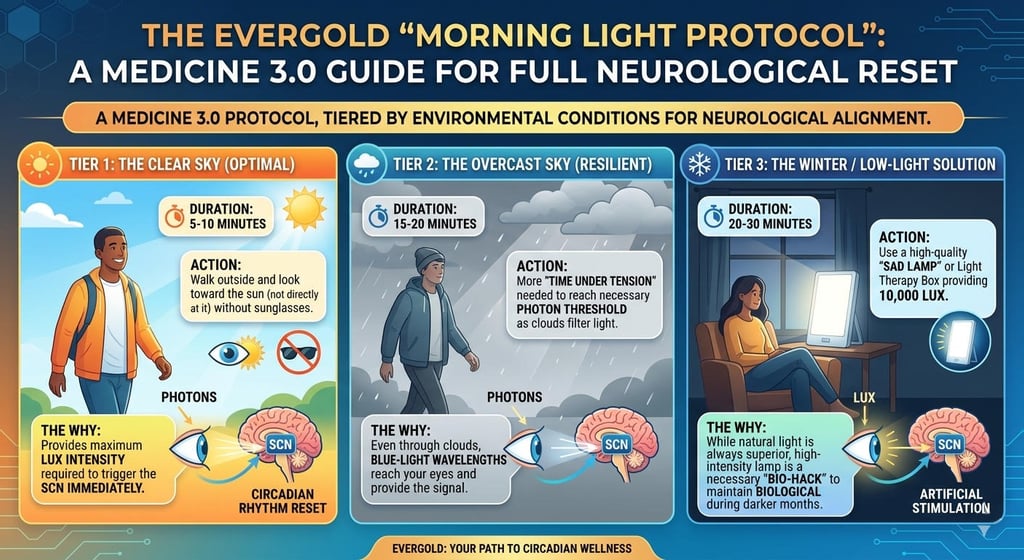
To achieve a full neurological reset, we recommend the following Medicine 3.0 protocol, tiered by environmental conditions.
Tier 1: The Clear Sky (Optimal)
Duration: 5 to 10 minutes.
Action: Walk outside and look toward the sun (not directly at it) without sunglasses.
The Why: This provides the maximum lux intensity required to trigger the SCN immediately.
Tier 2: The Overcast Sky (Resilient)
Duration: 15 to 20 minutes.
Action: Because the clouds filter the light, you need more "time under tension" to reach the necessary photon threshold.
The Why: Even through clouds, the blue-light wavelengths reach your eyes and provide the signal.
Tier 3: The Winter / Low-Light Solution
Duration: 20 to 30 minutes.
Action: Use a high-quality "SAD Lamp" or Light Therapy Box that provides 10,000 lux.
The Why: While natural light is always superior, a high-intensity lamp is a necessary "Bio-Hack" for maintaining biological capital during the darker months.
7. The Wildcard: The "Sunset Anchor"
In the spirit of diversity and "Anti-Tunneling," it is important to note that morning light has a powerful partner: Evening Sunlight.
The Mechanism: The low-angle, "amber" light of the setting sun informs the SCN that the day is ending. This shifts the melanopsin receptors and begins the transition from serotonin to melatonin.
The Evergold Take: Viewing the sunset "anchors" the other end of your circadian clock, making the morning reset even more effective.
8. Overcoming "Aging Insomnia"
Many seniors accept fragmented sleep as a natural part of aging. In the Medicine 3.0 framework, we view this largely as a "Circadian Signal Decay." As we age, our eyes become less efficient at transmitting light (due to lens yellowing or pupil constriction).
By increasing the intensity of your morning light exposure—effectively "turning up the volume" of the signal—you can override this age-related decay and restore the deep, consolidated sleep of your 40s.
Conclusion: The First Action of the Day
Building your biological legacy doesn't always require expensive supplements or complex gym routines. Sometimes, it requires the most primal action of all: standing under the sky and letting the sun speak to your brain.
The morning light is a daily opportunity to reboot your system, sharpen your mind, and protect your future. Don't waste the first hour of your day in the dark. Step outside, set your clock, and reclaim your energy.
Stay Bright. Stay Focused. Stay Evergold.
Contact
© 2026. All rights reserved.
DISCLAIMER
We love sharing information, but please remember we aren't doctors, lawyers, or financial advisors. Always check in with a professional before you start a new fitness routine, change your diet, or make big financial decisions. Your specific situation deserves expert attention.