
The $63 Billion Blind Spot: How Ageism is Stalling the Global Healthcare Revolution
The greatest barrier to the longevity revolution isn't a lack of biological breakthroughs; it is a structural economic inefficiency: Ageism. In 2026, the data is undeniable—age discrimination is no longer just a social "feel-good" issue; it is a multi-billion dollar drag on the global economy.
Evergold Longevity
4/13/20263 min read
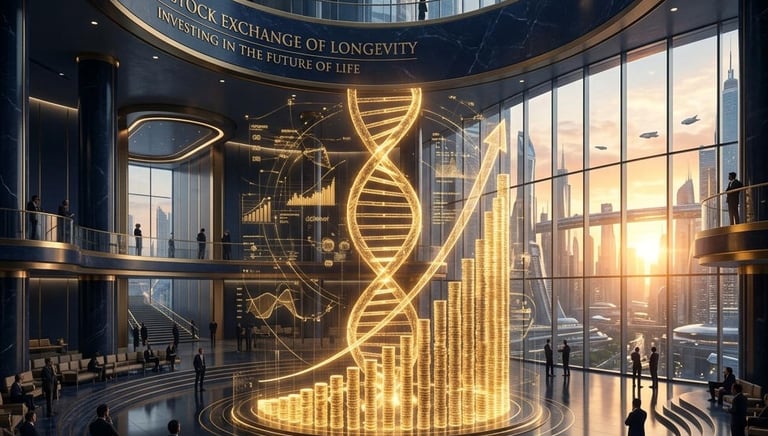
In the traditional economic discourse (Medicine 2.0), an aging population is almost exclusively viewed as a "Silver Tsunami"—a looming fiscal catastrophe characterized by skyrocketing pension costs and a shrinking tax base. The prevailing narrative treats the 60+ demographic as a "Cost Center" to be managed rather than an "Asset Class" to be optimized.
At EvergoldLongevity, we believe this perspective is not only socially regressive but mathematically flawed. The greatest barrier to the longevity revolution isn't a lack of biological breakthroughs; it is a structural economic inefficiency: Ageism. In 2026, the data is undeniable—age discrimination is no longer just a social "feel-good" issue; it is a multi-billion-dollar drag on the global economy.
1. The $63 Billion Invoice: The Hidden Cost of Bias
For decades, the healthcare costs associated with aging were assumed to be a biological inevitability. However, landmark economic analyses in 2025 and 2026 have revealed a different reality.
In the United States alone, ageism is responsible for an estimated $63 billion in excess healthcare spending annually. This staggering figure is derived from the eight most expensive chronic conditions—including cardiovascular disease, respiratory infections, and metabolic disorders—where the quality of care and the speed of intervention are statistically lower for older adults due to implicit bias.
The Mechanism of Waste
When a 65-year-old’s symptoms are dismissed as "just a part of getting older," the window for Medicine 3.0 prevention closes. Minor issues that could have been mitigated through precision metabolic optimization or structural fortification are allowed to escalate into acute, high-cost hospitalizations. We are essentially paying a "Bias Tax" that drains the healthcare system of the resources needed to fund the next generation of geroprotective research.
2. The "Silver Dividend": Reclaiming Cognitive Productivity
The traditional "Dependency Ratio"—the number of retirees supported by the working population—is based on the 20th-century assumption that productivity ends at 65. In the 2026 longevity economy, this metric is obsolete.
Boosting GDP through Extended Healthspan
By applying proactive longevity medicine—maintaining VO2 max, protecting lean muscle mass, and optimizing the DHA:EPA ratio for cognitive clarity—we create the "Silver Dividend." When we extend "Healthspan" to match "Lifespan," we don't just keep people alive longer; we keep them in the Cognitive Productivity Zone. An extra five years of healthy, high-functioning participation from the 60+ demographic represents a multi-trillion dollar boost to global GDP. Experience, mentorship, and "crystalized intelligence" are the rarest commodities in the 2026 workforce. Ageism is the filter that unnecessarily discards this capital.
3. From Dependency to Durability: The Medicine 3.0 ROI
The shift from "Anti-Ageism" to "Pro-Longevity Economics" requires a fundamental change in how we calculate Return on Investment (ROI).
In Medicine 2.0, the "ROI" of a treatment is measured by the delay of death. In the Evergold model, the ROI is measured by Biological Durability.
The Investment: Precision pharmacology (Rapamycin), structural loading (HiRIT), and metabolic switching (Berberine).
The Return: A reduction in long-term care dependency, a decrease in the "Bias Tax" on the healthcare system, and the maintenance of a high-value, tax-paying "Longevity Athlete."
4. The 2030 Pivot: Age-Agnostic Infrastructure
As we look toward 2030, the most successful economies will be those that build Age-Agnostic Infrastructure. This means workplaces designed for cognitive longevity, healthcare systems that treat "Aging" as a modifiable biomarker, and financial models that value health as the ultimate form of currency.
The companies and nations that continue to operate under the "Silver Tsunami" fear model will find themselves burdened by the $63 billion blind spot. Those that embrace the Longevity Economy will unlock a level of human potential and economic growth previously thought impossible.
Conclusion: The Ultimate Economic Frontier
The fight against ageism is no longer a battle for "fairness." It is a battle for Economic Survival. We cannot afford to ignore the $63 billion invoice that bias presents us every year.
The longevity revolution is here, but it requires more than just biological mastery. It requires us to stop viewing our elders as a liability and start treating the 60+ demographic as the most significant untapped economic engine of the 21st century.
Invest in Health. Defeat the Blind Spot. Stay Evergold.
Contact
© 2026. All rights reserved.
DISCLAIMER
We love sharing information, but please remember we aren't doctors, lawyers, or financial advisors. Always check in with a professional before you start a new fitness routine, change your diet, or make big financial decisions. Your specific situation deserves expert attention.