Rapamycin Beyond the PEARL Trial: Precision Geroprotection for the 2026 Longevity Senior
Rapamycin is not just a pill, but a Molecular Dial. To master Rapamycin in 2026 is to understand the "Implementation Gap" revealed by the landmark PEARL Trial and the emerging science of Immune Resilience.
Evergold Longevity
4/6/20264 min read


In the landscape of Medicine 2.0, Rapamycin (Sirolimus) was a "transplant drug"—a high-dose immunosuppressant used to prevent organ rejection. In the early 2020s, it transitioned into the "biohacker’s secret," touted by enthusiasts as a silver-bullet anti-aging pill. However, both narratives missed the mark of clinical precision.
At EvergoldLongevity, we view Rapamycin not as a pill, but as a Molecular Dial. It is a tool used to modulate the mTOR (mechanistic Target of Rapamycin) pathway—the body’s primary sensor for nutrient availability and cellular growth. To master Rapamycin in 2026 is to understand the "Implementation Gap" revealed by the landmark PEARL Trial and the emerging science of Immune Resilience.
1. The PEARL Trial: A 2025 Reality Check
Published in April 2025, the PEARL Trial (Participatory Evaluation (of) Aging (with) Rapamycin (for) Longevity) was the first large-scale, randomized, double-blind, placebo-controlled study on healthy human adults. For the longevity community, it was the "Great Clarifier."
While the headlines focused on the fact that Rapamycin did not significantly reduce visceral fat across the entire cohort, a deeper "Medicine 3.0" analysis reveals the nuances that general media missed. The trial proved that low-dose, intermittent Rapamycin (5–10 mg once weekly) is extraordinarily safe over a 48-week period, with no significant difference in side effects compared to the placebo.
However, the real value lay in the Secondary Endpoints. The trial proved that Rapamycin is not a "one-size-fits-all" intervention; it is a sex-specific biological modulator.
2. The Sex-Specific Breakthrough: Lean Mass and Pain Reduction
The most striking data from the PEARL trial emerged in the female cohort, specifically those in the 10 mg weekly group.
The Lean Mass Dividend
Contrary to the fear that mTOR inhibition might cause muscle wasting (due to its role in protein synthesis), women in the high-dose group showed a statistically significant improvement in lean mass. This suggests that by cleaning up cellular "junk" via autophagy, Rapamycin may actually improve the quality of muscle tissue, making it a critical tool in the fight against Sarcopenia.
Chronic Pain Mitigation
Perhaps more surprising was the reduction in perceived pain. Chronic, low-grade inflammation (Inflammaging) is a primary driver of musculoskeletal pain in the 60+ demographic. By dampening the SASP (Senescence-Associated Secretory Phenotype)—the "inflammatory exhaust" of zombie cells—Rapamycin acted as a systemic "fire extinguisher," improving quality of life in ways that weight-loss metrics failed to capture.
3. The Bioavailability Scandal: Why Your Source Matters
The most critical technical takeaway from 2025 involves a "Bioavailability Gap" that rendered many participants' efforts moot. The PEARL trial utilized compounded Rapamycin, which post-study analysis revealed had blood concentrations approximately 1/3 lower than standard commercial formulations (like Rapamune).
The EvergoldLongevity Insight: If you are using compounded Rapamycin without regular blood testing for Sirolimus levels, you are essentially flying blind. Here, we emphasize that the "Longevity Dose" is not what you swallow; it is the peak concentration (Cmax) reached in your blood. For the Skyscraper-level biohacker, generic commercial tablets or high-quality enteric-coated versions are the only ways to ensure the drug survives the stomach's acid to reach the mTOR receptors.
4. 2026 Frontiers: The "Kell Study" and Immune Resilience
Moving beyond the PEARL trial, 2026 has brought us groundbreaking research on Immunosenescence. A study led by Dr. Loren Kell (Oxford/Nottingham) has redefined how we view Rapamycin and the immune system.
The old fear was that Rapamycin suppresses the immune system. The 2026 data shows the opposite: low-dose cycling actually rejuvenates it. The Mechanism: Rapamycin reduces "DNA lesion loads" in T-lymphocytes.
The Result: By inhibiting the mTOR pathway intermittently, we allow the immune system’s "memory cells" to undergo a period of repair. This has been shown to effectively double the survival rate of immune cells under genotoxic stress, providing a literal "second wind" for the aging immune system.
5. The Evergold Rapamycin Protocol: Medicine 3.0 in Action
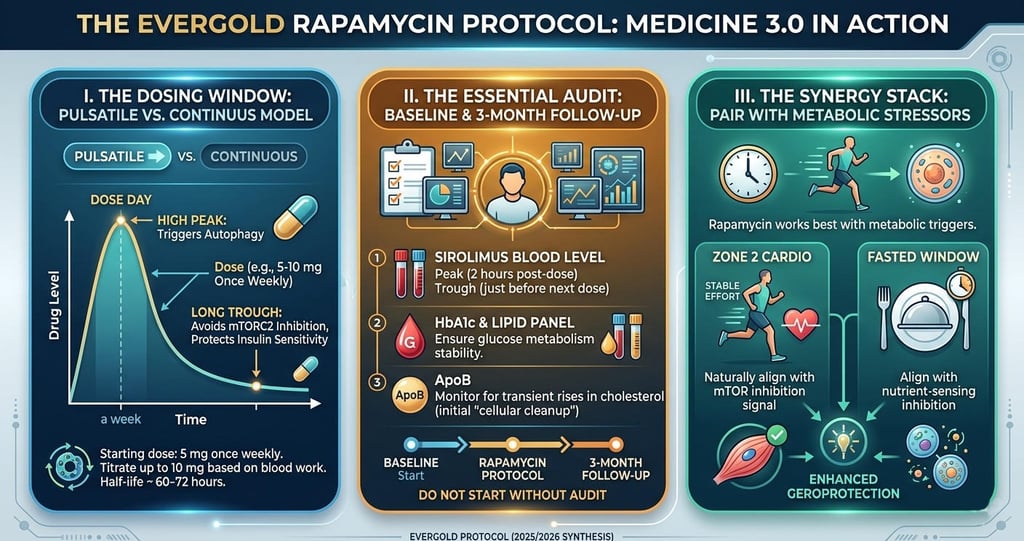
Based on the 2025/2026 synthesis, the EvergoldLongevity Protocol for Geroprotection follows a "Pulsatile" rather than a "Continuous" model.
I. The Dosing Window
We recommend a starting dose of 5 mg once weekly, potentially titrating up to 10 mg depending on blood work. The goal is a high "Peak" to trigger autophagy, followed by a long "Trough" (the half-life is roughly 60–72 hours) to avoid the inhibition of mTORC2, which could impact insulin sensitivity.
II. The Essential Audit
Do not start Rapamycin without a baseline and a 3-month follow-up of:
Sirolimus Blood Level: (Taken 2 hours post-dose for peak, and again at the trough).
Hba1c & Lipid Panel: To ensure glucose metabolism remains stable.
ApoB: To monitor for transient rises in cholesterol (often seen during the initial "cellular cleanup").
III. The Synergy Stack
Rapamycin works best when paired with Metabolic Stressors. We recommend taking your dose on a day that includes Zone 2 cardio or a fasted window, as these naturally align with the mTOR-inhibition signal.
6. The "Golden Rule" of mTOR: Protect the Growth Phase
Longevity is a balance between Anabolism (Growth) and Catabolism (Cleanup). You cannot be in "Cleanup Mode" 24/7.
The Mistake: Taking Rapamycin every day or in high doses during periods of intense muscle building.
The Fix: Use the "5-on, 2-off" approach for lifestyle, or cycle your Rapamycin "3 weeks on, 1 week off" to allow for periods of robust mTOR activation and protein synthesis.
Conclusion: Rapamycin as an Insurance Policy
In the Medicine 3.0 framework, Rapamycin is not a "fountain of youth." It is a sophisticated Insurance Policy for Biological Capital. It is the most evidence-backed tool we have for delaying the onset of age-related pathologies by slowing the fundamental "Clock of Attrition."
By moving beyond the simplistic headlines and addressing the bioavailability, sex-specific benefits, and immune-rejuvenating properties of this molecule, we transition from "guessing" at longevity to "engineering" it.
Stay Sharp. Stay Focused. Stay Evergold.
Contact
© 2026. All rights reserved.
DISCLAIMER
We love sharing information, but please remember we aren't doctors, lawyers, or financial advisors. Always check in with a professional before you start a new fitness routine, change your diet, or make big financial decisions. Your specific situation deserves expert attention.