Structural Integrity: The OsteoStrong Debate and the HiRIT Gold Standard
Currently, the market is divided between two philosophies: the low-friction, high-tech promise of OsteoStrong and the high-intensity, evidence-backed rigor of HiRIT (High-Intensity Resistance and Impact Training). For the 60+ professional, choosing the right protocol is the difference between "perceived" improvement and actual "biological" fortification.
Evergold Longevity
4/7/20265 min read
Transparency Note: We use affiliate links on this page. If you decide to buy something through these links, we may earn a small commission. This helps us keep the site running and provides you with free content. Thank you for the support!
In the traditional medical model (Medicine 2.0), bone health is treated as a slow, inevitable decline that is only addressed once it reaches the threshold of a clinical diagnosis: Osteopenia or Osteoporosis. The standard prescription? Calcium supplements, Vitamin D, and perhaps a bisphosphonate, once a fracture has already occurred.
At EvergoldLongevity, we view bone density as Structural Capital. It is a tangible asset that can be built, fortified, and aggressively defended well into your 80s and 90s. In the Medicine 3.0 era, the goal isn't just "preventing a break"; it is building a skeleton that can withstand the high-impact demands of a "Centenarian Decathlon."
Currently, the market is divided between two philosophies: the low-friction, high-tech promise of OsteoStrong and the high-intensity, evidence-backed rigor of HiRIT (High-Intensity Resistance and Impact Training). For the 60+ professional, choosing the right protocol is the difference between "perceived" improvement and actual "biological" fortification.
1. The OsteoStrong Phenomenon: 10 Minutes to Stronger Bones?
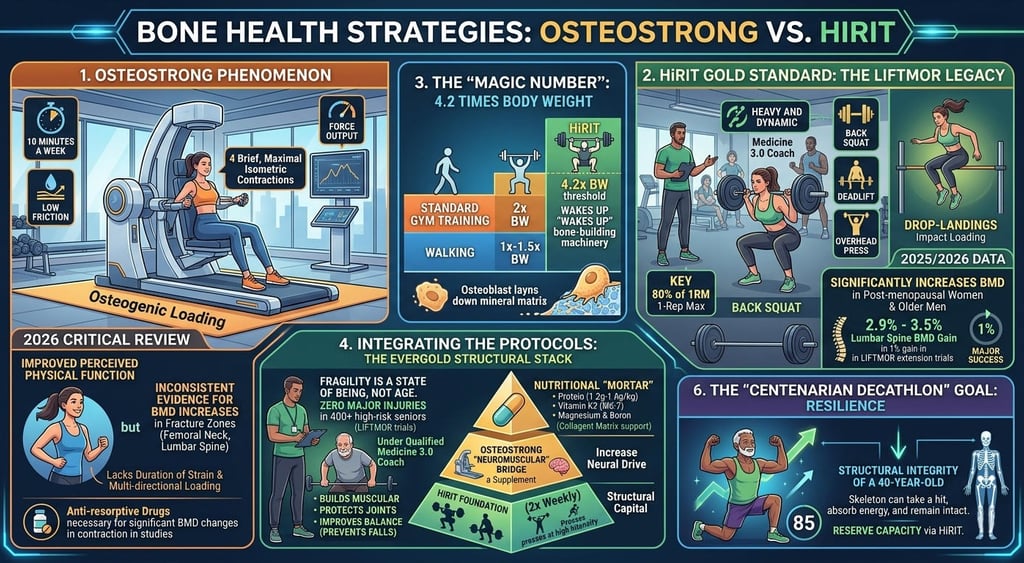
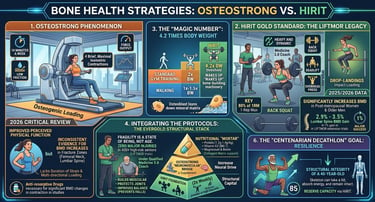
OsteoStrong has gained massive traction by promising the benefits of heavy lifting without the sweat or the risk of a gym environment. Utilizing "Osteogenic Loading" machines, users perform four brief, maximal isometric contractions designed to mimic the forces required to trigger bone growth.
The Appeal of Low Friction
The "10 minutes a week" model is a marketing masterstroke. For many in their 60s and 70s, the traditional weight room is intimidating or seemingly dangerous. OsteoStrong offers a controlled, robotic environment where the user pushes against a stationary bar, and a screen monitors the force output.
The 2026 Critical Review: Perceived vs. Biological Function
A comprehensive 2026 critical review of isometric-only technologies has introduced a necessary "reality check" to the industry. While the data shows that OsteoStrong can improve perceived physical function—meaning users feel stronger and move with more confidence—the evidence for actual increases in Bone Mineral Density (BMD) in the critical "fracture zones" (the femoral neck and lumbar spine) remains inconsistent.
Crucially, studies from 2025 indicated that while these isometric pulses are excellent for neuromuscular recruitment, they lack the "duration of strain" and the multi-directional loading required to signal the bone-building cells (osteoblasts) to lay down new mineral matrix at the same rate as traditional weight-bearing exercise. Without the concurrent use of anti-resorptive drugs, the BMD changes observed in OsteoStrong-only cohorts have largely failed to reach statistical significance in the hip and spine.
2. The HiRIT Gold Standard: The LIFTMOR Legacy
While OsteoStrong focuses on "Brief and Static," the HiRIT protocol focuses on "Heavy and Dynamic." Validated by the landmark LIFTMOR Trial (and subsequent 2025 follow-ups), HiRIT is currently the only exercise protocol proven to not just maintain, but significantly increase bone density in post-menopausal women and older men with low bone mass.
The Mechanism: 80% of 1RM
HiRIT stands for High-Intensity Resistance and Impact Training. Unlike standard "toning" exercises or light-weight repetitions, the HiRIT protocol requires users to lift at 80% of their One-Rep Max (1RM). The protocol consists of three primary compound movements:
Deadlifts: For posterior chain and hip density.
Back Squats: For femoral and spinal loading.
Overhead Presses: For upper body and spinal integrity.
Impact Loading: High-jump "drop-landings" to provide the sudden mechanical "jolt" that bones thrive on.
The 2025/2026 Data: Real BMD Gains
Data from the 2025 LIFTMOR extension trials showed that seniors (average age 65-78) who engaged in twice-weekly 30-minute HiRIT sessions saw a 2.9% to 3.5% increase in BMD at the lumbar spine and significant increases in the femoral neck. In the world of bone health, where a 1% gain is considered a major success, these results are revolutionary.
3. The "Magic Number": 4.2 Times Body Weight
Why does HiRIT work when "Weight-Bearing Walk" or "Light Resistance" fails? It comes down to a biological threshold. Research suggests that to trigger osteogenesis in the hip, the bone must experience a load of approximately 4.2 times your body weight.
Walking provides about 1x to 1.5x body weight. Traditional gym "strength training" often hovers around 2x. HiRIT, through heavy deadlifts and squats, is the only protocol that consistently and safely hits the 4x+ threshold required to "wake up" the bone-building machinery.
4. The Safety Myth: "Is Lifting Heavy Dangerous for Seniors?"
The primary barrier to HiRIT is fear. Medicine 2.0 has conditioned us to believe that as we age, our bodies become "fragile" and should be wrapped in bubble wrap.
The EvergoldLongevity Perspective: Fragility is a state of being, not a byproduct of age. In the LIFTMOR trials, involving over 400 high-risk seniors, there were zero major injuries. Under the supervision of a qualified Medicine 3.0 coach, heavy lifting is not only safe; it is the antidote to the fragility that leads to fractures.
By controlled, progressive loading, we don't just build bone; we build the muscular "armor" that protects the joints and the proprioception (balance) that prevents falls in the first place.
5. Integrating the Protocols: The Evergold Structural Stack
In the spirit of "Anti-Tunneling," we do not suggest that the gym is the only answer. A truly optimized skeleton requires a multi-modal approach.
Tier 1: The HiRIT Foundation (2x Weekly)
Twice-weekly sessions focused on the "Big Three" (Squat, Deadlift, Press) at high intensity. This is your primary "Structural Capital" investment.
Tier 2: The OsteoStrong "Neuromuscular" Bridge
If you have access to an OsteoStrong center, use it as a supplement to—not a replacement for—heavy lifting. It is an excellent tool for increasing the "Neural Drive" (the ability of your brain to tell your muscles to fire at maximum capacity).
Tier 3: The Nutritional "Mortar"
Bones are not just calcium; they are a protein matrix. To support HiRIT, your Medicine 3.0 stack must include:
Protein: 1.2g to 1.6g per kg of body weight to support the collagen matrix of the bone.
Vitamin K2 (MK-7): The "traffic cop" that tells calcium to go into the bones rather than the arteries.
Magnesium & Boron: Trace minerals essential for bone mineralization.
6. The "Centenarian Decathlon" Goal: Resilience
The ultimate goal of bone density is Resilience. If you fall at age 85, you want the structural integrity of a 40-year-old. You want a skeleton that can take a hit, absorb the energy, and remain intact. HiRIT provides that "Reserve Capacity."
Conclusion: Choose Evidence Over Ease
The promise of a "10-minute solution" is alluring, but biological evolution rarely rewards the path of least resistance. Our bones evolved to support us in a world of gravity, impact, and heavy lifting.
If you want to maintain your independence, your mobility, and your height into your 90s, you must move beyond the "perceived function" of isometric machines and embrace the "biological reality" of heavy mechanical loading. Your skeleton is the foundation of your future. Build it on the gold standard of HiRIT.
Stay Strong. Stay Functional. Stay Evergold.
Contact
© 2026. All rights reserved.
DISCLAIMER
We love sharing information, but please remember we aren't doctors, lawyers, or financial advisors. Always check in with a professional before you start a new fitness routine, change your diet, or make big financial decisions. Your specific situation deserves expert attention.