
Pelvic Floor Health: The Hidden Foundation of Functional Mobility
The pelvic floor is not an isolated group of muscles; it is the physiological floor of your entire core canister. It is a critical component of your "Biological Capital."
Evergold Longevity
3/30/20264 min read
In the traditional medical landscape (Medicine 2.0), the pelvic floor is rarely discussed until something goes wrong. It is a topic often relegated to postpartum recovery or the late-stage management of incontinence. In these contexts, the conversation is reactive, focused on mitigation rather than optimization.
At Evergold, we view the body through the lens of Medicine 3.0. We recognize that the pelvic floor is not an isolated group of muscles; it is the physiological floor of your entire core canister. It is a critical component of your "Biological Capital" that dictates your ability to lift, breathe, balance, and move with power. To ignore the pelvic floor is to ignore the foundation of functional mobility.
1. The Core Canister: A Masterpiece of Pressure Management
To understand the pelvic floor, we must stop viewing it as a "hammock" and start viewing it as a dynamic pressure regulator. Your core is effectively a pressurized canister:
The Top: The Diaphragm.
The Sides: The Transverse Abdominis and Obliques.
The Back: The Multifidus and spinal stabilizers.
The Bottom: The Pelvic Floor.
Every time you take a breath, lift a grocery bag, or perform a heavy squat, these four components must work in perfect synchronization to manage Intra-Abdominal Pressure (IAP). If the "floor" of this canister is weak or hypertonic (overly tight), the entire system fails. This failure manifests not just as pelvic dysfunction, but as chronic lower back pain, hip instability, and reduced power output in the "Centenarian Decathlon."
2. The Link Between Pelvic Health and Hip Mobility
In the 60+ demographic, "tight hips" are a ubiquitous complaint. However, Medicine 3.0 reveals a fascinating bi-directional relationship: the pelvic floor and the deep hip rotators share the same fascial plane.
The Obturator Internus, a key deep rotator of the hip, is physically attached to the pelvic floor muscles. If your pelvic floor is dysfunctional, your hips will often "lock down" to provide the stability that the core is failing to give.
The Evergold Insight: You cannot have truly mobile, powerful hips without a functional pelvic floor. Many people spend years stretching their hip flexors with no relief, when the actual solution lies in restoring the neurological connection to the pelvic base.
3. Beyond "Kegels": The Fallacy of Constant Contraction
For decades, the standard advice has been "do your Kegels." While well-intentioned, this advice is often incomplete and sometimes counterproductive.
Just like any other muscle, the pelvic floor requires a full range of motion. It needs the ability to contract (for stability and continence) and the ability to lengthen and relax (for waste elimination and pressure management). Many active adults actually suffer from a "hypertonic" or "non-relaxing" pelvic floor. Constantly "squeezing" creates a rigid floor that cannot absorb shock, leading to increased pressure on the lower back and a higher risk of injury during explosive movements.
4. Pelvic Health for Men: The Overlooked Vital Sign
A common misconception is that pelvic floor health is exclusively a "women's issue." In the Medicine 3.0 framework, we recognize that for men, a functional pelvic floor is a critical determinant of:
Prostate Health: Proper muscle function aids in lymphatic drainage and reduces pelvic congestion.
Erectile Function: The pelvic floor muscles are responsible for maintaining blood flow and pressure—training these muscles has been shown to be as effective as pharmaceutical interventions for some types of erectile dysfunction.
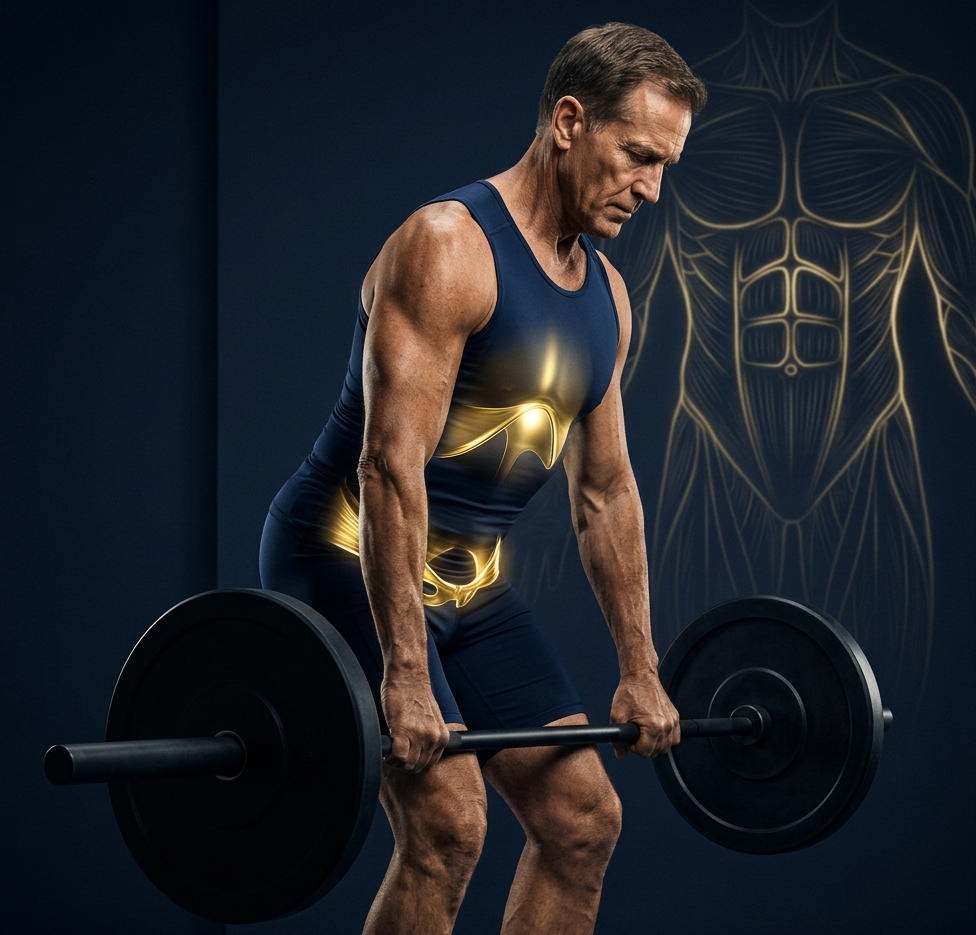
Core Power: For the male Evergold Athlete, a strong pelvic floor is the "anchor" for heavy deadlifts and rucking.
5. The Functional Impact: Balance and Fall Prevention
As explored in our protocols for yoga and balance, stability is a multi-system calculation. The pelvic floor plays a surprising role in your Proprioceptive system. Because it is so closely linked to the deep core and the diaphragm, it helps the brain determine the body's center of gravity (CoG).
When the pelvic floor is engaged and responsive, it stabilizes the pelvis, which in turn provides a steady base for the spine and head. This "bottom-up" stability is what allows you to recover from a trip or a slip. A resilient pelvic floor is, quite literally, part of your fall-prevention "insurance policy."
6. The Evergold Pelvic Integration Protocol
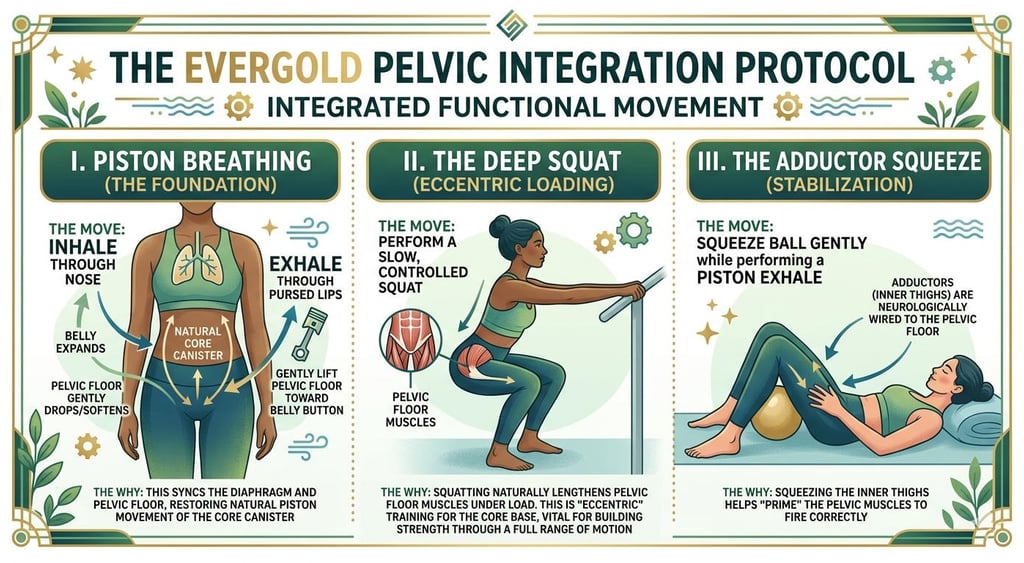
We do not believe in isolated exercises. We believe in Integrated Functional Movement. Here is how to incorporate pelvic health into your daily routine:
I. Piston Breathing (The Foundation)
The Move: Inhale through the nose, allowing the belly to expand and the pelvic floor to gently "drop" or soften. As you exhale through pursed lips, imagine gently "lifting" the pelvic floor toward your belly button.
The Why: This syncs the diaphragm and the pelvic floor, restoring the natural "piston" movement of the core canister.
II. The Deep Squat (Eccentric Loading)
The Move: Perform a slow, controlled squat (use a chair or rail for balance if needed).
The Why: Squatting naturally lengthens the pelvic floor muscles under load. This is "eccentric" training for the core base, which is vital for building strength through a full range of motion.
III. The Adductor Squeeze (Stabilization)
The Move: While lying on your back with knees bent, place a soft ball or pillow between your knees. Gently squeeze the ball as you perform a "piston exhale."
The Why: The adductors (inner thighs) are neurologically "wired" to the pelvic floor. Squeezing the inner thighs helps "prime" the pelvic muscles to fire correctly.
7. When to Consult a Specialist: The Pelvic Floor PT
In Medicine 3.0, we use every tool available. If you experience chronic pelvic pain, persistent "leaking" during exercise, or unexplained lower back pain, the most high-yield intervention is a visit to a Pelvic Floor Physical Therapist. Unlike a general practitioner, these specialists use internal and external biofeedback to determine if your muscles are too weak, too tight, or simply "out of sync" with your breathing. This is the "Precision Medicine" approach to core health.
Conclusion: Reclaiming the Foundation
Pelvic floor health is not about "managing age"; it is about mastering movement. It is the structural "basement" of your physical frame. By integrating pelvic awareness into your breathing, your lifting, and your daily walking, you are reinforcing the integrity of your entire body.
In your "Second Act," every movement should be supported from the ground up. Protect your foundation, build your Biological Capital, and move with the confidence of a fully integrated athlete.
Stay Strong. Stay Flexible. Stay Evergold.
Contact
© 2026. All rights reserved.
DISCLAIMER
We love sharing information, but please remember we aren't doctors, lawyers, or financial advisors. Always check in with a professional before you start a new fitness routine, change your diet, or make big financial decisions. Your specific situation deserves expert attention.