
Yoga for Balance: Preventing Falls Before They Happen
Balance is not a static trait—it is a high-performance skill. Yoga, when stripped of its mystical tropes and viewed through the lens of biomechanics and neurology, is perhaps the most effective system ever devised for "Fall Insurance."
Evergold Longevity
3/25/20264 min read
In the world of Medicine 2.0, fall prevention is often treated as a reactive, "damage control" strategy. We install grab bars in showers, remove rugs, and tell our elders to "be careful." While well-intentioned, this approach is fundamentally rooted in the acceptance of decline.
At EvergoldLongevity, we operate in the Medicine 3.0 paradigm. We don’t want to just make your environment safer; we want to make you more resilient. In this framework, balance is not a static trait—it is a high-performance skill that can be trained, optimized, and preserved well into your 90s.
Yoga, when stripped of its mystical tropes and viewed through the lens of biomechanics and neurology, is perhaps the most effective system ever devised for "Fall Insurance."
1. The High Stakes of Verticality
To understand why balance training is a non-negotiable pillar of longevity, we must look at the data. For individuals over the age of 65, a fall is not just an accident; it is a clinical pivot point. A hip fracture carries a one-year mortality rate of nearly 20-30%. More importantly, the fear of falling often leads to a self-imposed restriction of activity, which accelerates muscle wasting (Sarcopenia) and cognitive decline.
Preventing the first fall is the single most effective way to protect your "Biological Capital."
2. The Neurology of Balance: The Three Pillars
Balance is a complex "real-time" calculation performed by your brain, integrating data from three distinct systems. Yoga is unique because it challenges all three simultaneously.
I. The Vestibular System (The Inner Ear)
Located in the inner ear, this system detects the head's position and movement in space.
The Yoga Connection: Poses that involve tilting the head or transitioning from high to low (like Sun Salutations) recalibrate the vestibular system, ensuring your internal "gyroscope" remains accurate.
II. The Visual System
Your eyes provide constant feedback about your body’s position relative to the horizon.
The Yoga Connection: Balancing on one leg while fixing your gaze on a static point (Drishti) trains the brain to use visual data to stabilize the core. Advanced practitioners eventually close their eyes, forcing the other two systems to "level up."
III. Proprioception (The "Sixth Sense")
Proprioception is your brain's ability to sense where your limbs are without looking at them, powered by receptors in your muscles, tendons, and joints.
The Yoga Connection: Yoga is performed barefoot. This is critical. The soles of the feet contain thousands of nerve endings that provide the brain with a "high-resolution map" of the ground. By engaging the "Four Corners" of the foot in a pose like Tadasana (Mountain Pose), you are sharpening your proprioceptive software.
3. The Biomechanics of the "Save"
When you stumble, your ability to prevent a fall depends on Eccentric Strength and Reaction Time.
Most traditional gym exercises focus on the concentric phase (lifting the weight). Yoga focuses heavily on the isometric (holding) and eccentric (slowly lowering) phases. When you hold a Warrior II pose, you are training your muscles to maintain tension under load. This is the exact type of strength required to "catch" yourself when you lose your center of gravity (CoG).
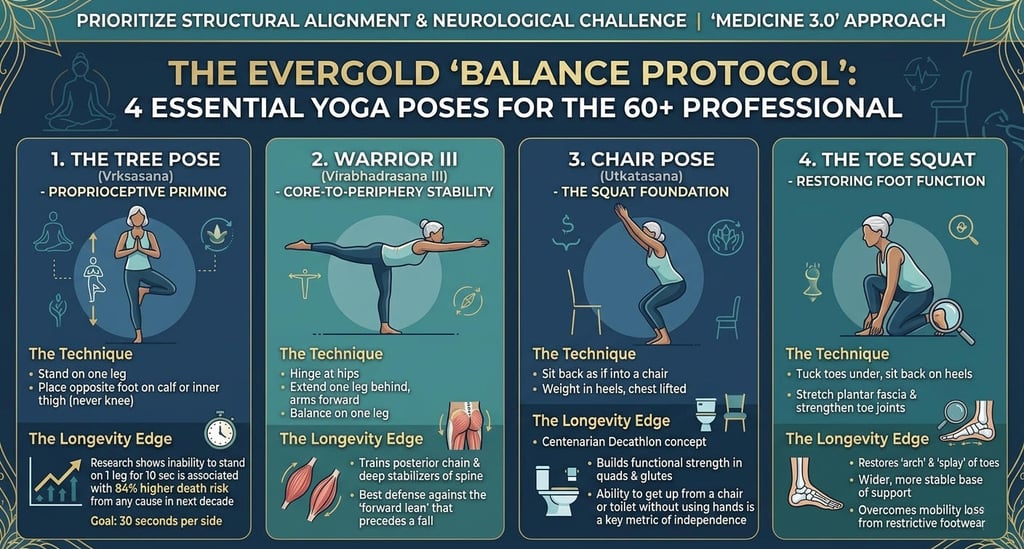
4. The Evergold "Balance Protocol": 4 Essential Poses
For the 60+ professional, we recommend a "Medicine 3.0" approach to yoga: prioritize structural alignment and neurological challenge over "flexibility" for its own sake.
I. The Tree Pose (Vrksasana) - Proprioceptive Priming
This is the gold standard for single-leg stability.
The Technique: Stand on one leg, placing the sole of the opposite foot on your calf or inner thigh (never the knee).
The Longevity Edge: Research shows that the inability to stand on one leg for 10 seconds is associated with an 84% higher risk of death from any cause within the next decade. Aim for 30 seconds per side.
II. Warrior III (Virabhadrasana III) - Core-to-Periphery Stability
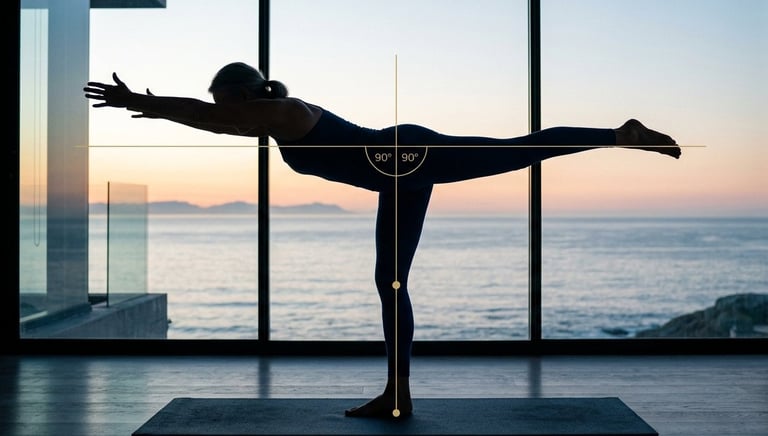
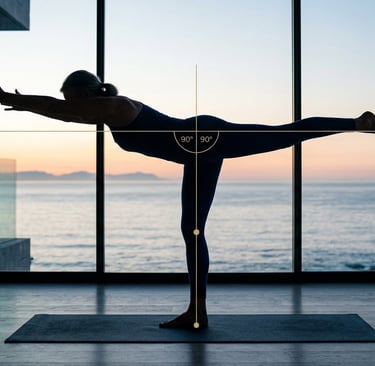
This pose requires you to hinge at the hips until your body forms a "T" shape.
The Technique: Balancing on one leg, extend the other leg behind you and your arms forward.
The Longevity Edge: This trains the posterior chain (glutes and hamstrings) and the deep stabilizers of the spine. A strong posterior chain is the best defense against the "forward lean" that often precedes a fall.
III. Chair Pose (Utkatasana) - The Squat Foundation
The Technique: Sit back as if into an invisible chair, keeping the weight in your heels and the chest lifted.
The Longevity Edge: This builds functional strength in the quads and glutes. In the "Centenarian Decathlon," the ability to get up from a chair or toilet without using your hands is a key metric of independence.
IV. The Toe Squat - Restoring Foot Function
The Technique: Tucking your toes under, sit back on your heels to stretch the plantar fascia and strengthen the toe joints.
The Longevity Edge: We lose foot mobility as we age due to restrictive footwear. Restoring the "arch" and "splay" of the toes gives you a wider, more stable base of support.
5. Overcoming "Fear of Falling" (FOF)
Anxiety is a significant, often overlooked risk factor for falls. When we are anxious, our bodies stiffen, our center of gravity rises, and our movements become jerky. This "stiffness" actually makes us more likely to fall.
Yoga addresses this through Pranayama (Breathwork). By engaging in "Ujjayi" breathing (deep, rhythmic nasal breathing), we stimulate the Vagus Nerve and shift the nervous system from Sympathetic (fight or flight) to Parasympathetic (rest and digest).
The Result: A calm mind leads to a fluid body. When you are relaxed, your muscles can react faster and more accurately to a slip.
6. Integrating Yoga into a Medicine 3.0 Life
You don’t need a 90-minute class to see results. At Evergold, we advocate for "Micro-Practices."
The "Toothbrush Challenge": Stand on one leg while brushing your teeth (2 minutes morning and night).
The "Post-Meal Reset": 5 minutes of Mountain Pose and Toe Squats after dinner to aid digestion and prime your balance systems for the next day.
Conclusion: Empowerment, Not Just Prevention
Falling is not an inevitable consequence of aging. It is a failure of the systems that maintain our verticality. By using yoga as a targeted, neurological training tool, we do more than "prevent falls." We reclaim the confidence to move through the world with grace, speed, and power.
Your "Second Act" should be spent on your feet, not in a chair. Start building your balance today.
Stay Strong. Stay Flexible. Stay Evergold.
Contact
© 2026. All rights reserved.
DISCLAIMER
We love sharing information, but please remember we aren't doctors, lawyers, or financial advisors. Always check in with a professional before you start a new fitness routine, change your diet, or make big financial decisions. Your specific situation deserves expert attention.