
Emergency Response Tech: Modern Alternatives to "I’ve Fallen and I Can’t Get Up"
The technology has finally caught up to our lifestyle. In 2026, emergency response tech is invisible, intelligent, and integrated into the devices we already love.
Evergold Longevity
2/16/20264 min read
Transparency Note: We use affiliate links on this page. If you decide to buy something through these links, we may earn a small commission. This helps us keep the site running and provides you with free content. Thank you for the support!
We all remember the commercial. The grainy footage, the dramatic music, and the catchphrase that launched a thousand late-night comedy sketches: "I’ve fallen and I can’t get up!" For decades, that plastic lanyard with the giant red button was the only line of defense for a senior living independently. It was a symbol of vulnerability—a "Med-Alert" badge that many felt announced their frailty to the world.
But in the Evergold era, we view safety not as a reaction to decline, but as a foundation for boldness. We aren't just trying to "not die" in our homes; we are trying to live with the confidence that our "marginal decade" will be spent rucking, gardening, and traveling.
The technology has finally caught up to our lifestyle. In 2026, emergency response tech is invisible, intelligent, and integrated into the devices we already love. Whether you are a solo-living biohacker or an active couple training for your Centenarian Decathlon, it is time to retire the lanyard and upgrade to a "Medicine 3.0" safety net.
1. The Physics of the Fall: Why "Smart" Detection Matters
Falls are the leading cause of injury-related visits to the ER for the 60+ generation. But the injury often isn't just the impact; it’s the "Long Lie"—the hours spent on the floor before help arrives, which can lead to dehydration, pressure sores, and psychological trauma.
Modern tech uses a combination of Accelerometers (measuring speed) and Gyroscopes (measuring orientation) to detect the "signature" of a fall.
The Science of "Impact vs. Intent"
A smart device has to distinguish between you dropping into a low squat (good!) and you collapsing (bad). To do this, it measures the change in $G$-force. A typical hard fall involves a rapid acceleration followed by a sudden deceleration exceeding $5.0 G$ to $7.0 G$.
$$F = m \cdot a$$
If the device detects this force ($F$) followed by a period of total stillness (lack of $a$), the "Medical 3.0" algorithm kicks in. It doesn't just wait for you to press a button; it proactively asks, "It looks like you’ve taken a hard fall. Do you need help?"
2. Wearables: The Invisible Guardian
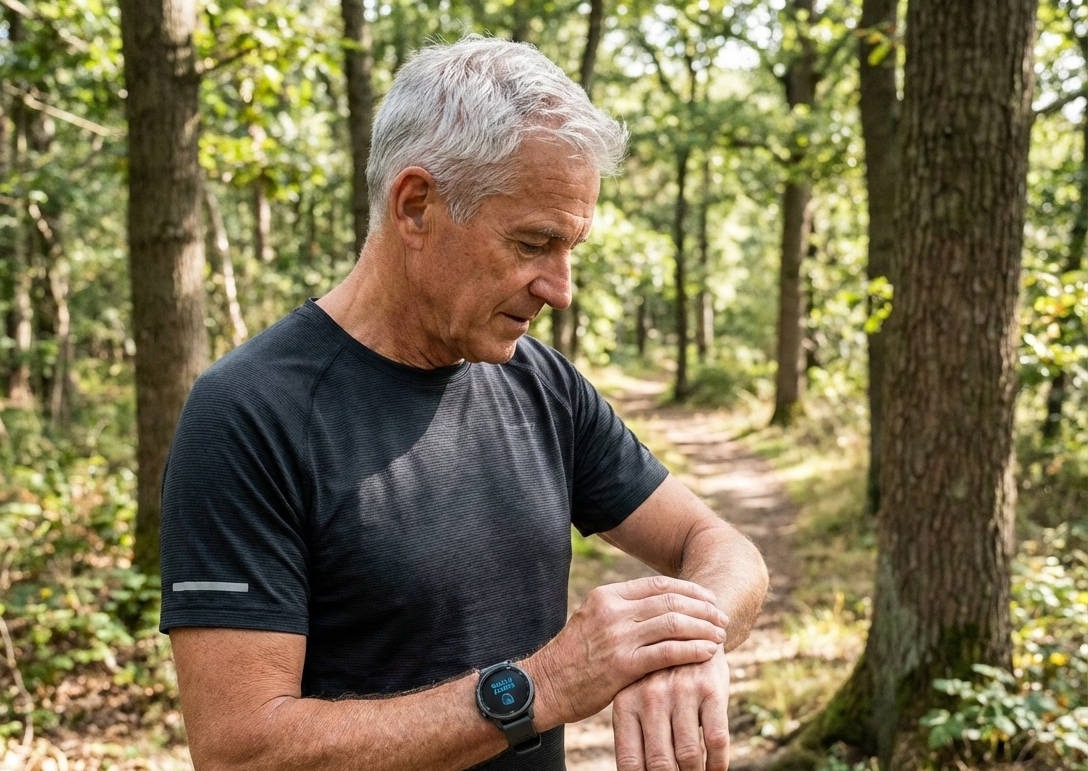
The most popular alternative to the old-school pendant is the smartwatch. For the Evergold reader, this is the most seamless transition.
Apple Watch & Pixel Watch
These are the current leaders in "on-person" fall detection.
The Benefit: If you are unresponsive, the watch uses its internal GPS and cellular connection to call emergency services and provide your exact coordinates.
The Evergold Edge: It also sends your Medical ID (allergies, medications, blood type) to the responders while simultaneously alerting your family.
Garmin (Incident Detection)
For the hikers and rucking enthusiasts, Garmin’s "Incident Detection" is superior for outdoor adventures. It can alert your emergency contacts if it detects a crash during a bike ride or a fall on a trail, even in areas with spotty cell service (if paired with an inReach satellite communicator).
3. Ambient Sensors: Safety Without the "Watch"
One of the biggest complaints we hear at Evergold is: "I don't want to wear a watch to bed or in the shower." Statistically, the bathroom is the most dangerous room in the house due to wet surfaces.
This is where Ambient Sensing comes in. These devices use radar or LiDAR to "see" your body without using cameras, preserving your privacy.
Vayyar Care & Nobi
These are wall-mounted or ceiling-integrated sensors (some even look like designer light fixtures).
How it works: They emit low-power radio waves that map the room. They can detect if a person is standing, sitting, or lying on the floor.
The Biohacker Benefit: Because they track movement patterns, they can also alert family members if your "nighttime bathroom trips" suddenly double, which could be an early sign of a UTI or other medical issues.
4. The Voice-Activated Safety Net
If you have a smart home setup (Alexa, Google Home, or Apple HomePod), you already have an emergency response system—you just haven't "hired" it yet.
Alexa Together: This is a subscription service specifically for seniors. It allows you to say, "Alexa, call for help," which connects you to a 24/7 urgent response agent.
The Integration: It can also sync with third-party fall detection sensors. If a sensor in the hallway detects a fall, Alexa can "drop in" to ask if you’re okay and call for help if you don't respond.
5. Specialized "Sleek" Tech: Beyond the Pendant
If you prefer a dedicated medical alert device because of its superior battery life or 24/7 monitoring center, look toward the "New School" of PERS (Personal Emergency Response Systems).
AloSafe: These devices are designed to look like high-end jewelry or minimalist keychains. No one knows you are wearing an emergency button.
Lively (formerly GreatCall): They offer a "Jitterbug" phone that features a dedicated 5Star button, connecting you to highly trained agents who can even help you if you’re just feeling unsafe walking to your car at night.
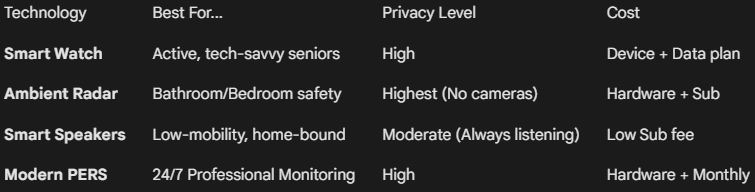
6. The Evergold Comparison Matrix
7. Action Step: Setting Up Your "Circle of Trust"
Regardless of the tech you choose, the system is only as good as the people it alerts. We recommend the "Evergold Circle" approach:
Professional Responders: Your device should always be set to call 911 (or local equivalent).
The "Nearby" Contact: A neighbor or friend within 10 minutes of your home who has a key.
The "Family" Contact: The person who manages your medical history and can coordinate with doctors.
The Golden Hour: In emergency medicine, the "Golden Hour" is the period following a traumatic injury where prompt medical treatment has the highest likelihood of preventing death. Modern tech ensures that even if you can't reach a phone, your "Golden Hour" isn't wasted.
Conclusion: Independence Through Intelligence
The fear of "falling and not being able to get up" has kept many seniors from living the expansive, adventurous lives they deserve. It has forced families into difficult conversations about assisted living far sooner than necessary.
By embracing modern emergency response tech, you aren't admitting defeat; you are installing an "invisible safety harness." You are choosing to be a "Medicine 3.0" senior—one who is protected by physics, monitored by intelligence, and empowered by the freedom to live exactly where and how you choose.
Contact
© 2026. All rights reserved.
DISCLAIMER
We love sharing information, but please remember we aren't doctors, lawyers, or financial advisors. Always check in with a professional before you start a new fitness routine, change your diet, or make big financial decisions. Your specific situation deserves expert attention.