
Is a Smart Watch Worth It for Longevity Tracking?
In this deep dive, we evaluate whether the smart watch is a gimmick or a "Medicine 3.0" essential for the 60+ generation. We will look at heart health, safety, and the "gold standard" of longevity metrics: $VO_2$ Max.
Evergold Longevity
2/5/20264 min read
Transparency Note: We use affiliate links on this page. If you decide to buy something through these links, we may earn a small commission. This helps us keep the site running and provides you with free content. Thank you for the support!
As we navigate the "Marginal Decade"—that final period of our lives where we strive to maintain the highest possible level of function—the tools we choose to assist us become paramount. In the Evergold community, we often debate the merits of different wearables. We’ve looked at the Oura Ring and its alternatives, but the most persistent question remains: Is a smart watch actually worth it?
For some, a smart watch feels like a tether—a constant, buzzing "nag" on the wrist. For others, it is a medical-grade cockpit, providing real-time telemetry on the most important engine they will ever own: their body.
In this deep dive, we evaluate whether the smart watch is a gimmick or a "Medicine 3.0" essential for the 60+ generation. We will look at heart health, safety, and the "gold standard" of longevity metrics: $VO_2$ Max.
1. The Heart of the Matter: Beyond the Pulse
Most basic fitness trackers can tell you your heart rate. But for someone in their 60s or 70s, "pulse" is just the tip of the iceberg. A true smart watch (like the Apple Watch Series 10 or the Garmin Venu 3) acts as a sentinel for cardiovascular health.
The ECG and Atrial Fibrillation (AFib)
One of the greatest risks as we age is AFib—an irregular heart rhythm that can lead to blood clots, stroke, and heart failure. Many people live with "silent" AFib, unaware of the storm brewing in their chest.
Modern smart watches feature FDA-cleared ECG (Electrocardiogram) apps. By simply placing your finger on the crown of the watch, you can generate a waveform that looks for signs of irregularity.
While it is not a replacement for a clinical 12-lead ECG at your cardiologist's office, it is an incredible "early warning system." For the Evergold biohacker, this isn't just a feature; it's peace of mind.
Heart Rate Variability (HRV)
We’ve discussed HRV in our other guides, but it bears repeating: HRV is a window into your nervous system. A high HRV suggests your body is resilient and recovering well. A sudden drop in HRV often predicts illness 24 to 48 hours before you feel a single sniffle. Watches are particularly good at tracking this throughout the day, providing a more dynamic picture than a ring that only measures it during sleep.
2. The Safety Net: Fall Detection and Independence
One of the biggest fears of aging is the "silent fall"—the moment when mobility is lost and help isn't nearby. This is where the smart watch transcends "fitness" and enters the realm of Essential Life Tech.
Fall Detection
High-end smart watches use advanced accelerometers and gyroscopes to detect the specific "signature" of a hard fall. If the watch detects a fall and then senses that you are immobile for 60 seconds, it doesn't just beep—it acts. It can automatically call emergency services and send your exact GPS coordinates to your designated "Evergold" emergency contacts.
Walking Steadiness
Apple specifically has introduced a metric called "Walking Steadiness." By analyzing the "shimmer" and "symmetry" of your gait as the watch sits on your wrist (or your phone sits in your pocket), it can categorize your fall risk as "OK," "Low," or "Very Low."
The Longevity Hack: If your watch tells you your steadiness is "Low," it’s time to double down on the Centenarian Decathlon training—focusing on lateral lunges and balance exercises before a fall actually happens.
3. The $VO_2$ Max: Your Longevity Horsepower
If you ask a longevity expert like Dr. Peter Attia what the most important number in your life is (besides your ApoB), they will likely say your $VO_2$ Max.
$VO_2$ Max is a measure of the maximum amount of oxygen your body can utilize during intense exercise. It is the single best proxy for your cardiorespiratory fitness and a powerful predictor of lifespan.
Why a Watch?
Measuring $VO_2$ Max accurately usually requires a laboratory, a treadmill, and a mask that measures your breath. However, smart watches have become incredibly adept at estimating this number by correlating your heart rate with your walking or running speed.
The 60+ Reality: A 70-year-old with a $VO_2$ Max in the "Elite" category for their age has a lower mortality risk than a 50-year-old with a "Poor" $VO_2$ Max. The watch allows you to track this "Longevity Horsepower" month-over-month, giving you a concrete goal for your rucking or brisk walking sessions.
4. The "Anti-Watch" Argument: Screen Fatigue and Blue Light
We wouldn't be authentic collaborators if we didn't address the downsides. Biohacking isn't just about adding tech; it's about removing friction.
Digital Noise: For many seniors, the constant "pings" of a smart watch are a source of stress. To combat this, we recommend "Evergold Focus Mode"—disabling all notifications except for phone calls from family and health alerts.
Sleep Disruption: While watches track sleep, they are bulkier than rings. If the watch is so uncomfortable that it ruins your sleep, it is actually hurting your longevity.
Battery Anxiety: Having one more thing to charge can be a burden. If you find the Apple Watch's 18-to-36-hour battery life frustrating, a Garmin (which can last 10–14 days) is a much better "set it and forget it" alternative.
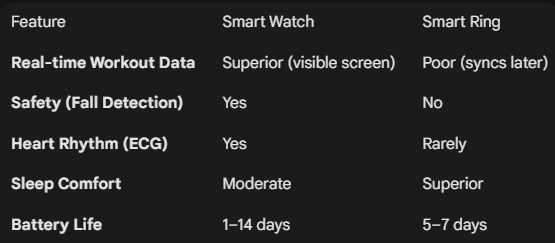
5. Smart Watch vs. Smart Ring: The Verdict
Which one is worth it for the Evergold reader?
The Evergold Recommendation: If you are still highly active and focused on building "Cognitive Reserve" and "Physical Horsepower," the Smart Watch is worth it. The combination of fall detection, ECG, and $VO_2$ Max tracking makes it a foundational tool for "Medicine 3.0."
Conclusion: A Compass for the Marginal Decade
A smart watch isn't just a gadget to tell you how many steps you took; it’s a compass. It tells you when to push, when to rest, and when to see a doctor. In your 60s and 70s, information is the difference between a reactive life and a proactive one.
If you can handle the "digital noise" and find a model that feels comfortable, the smart watch is perhaps the most significant investment you can make in your personal longevity infrastructure.
Contact
© 2026. All rights reserved.
DISCLAIMER
We love sharing information, but please remember we aren't doctors, lawyers, or financial advisors. Always check in with a professional before you start a new fitness routine, change your diet, or make big financial decisions. Your specific situation deserves expert attention.