
Creatine for Seniors: It’s Not Just for Bodybuilders (Muscle & Brain)
In the framework of Medicine 3.0, that image is tragically outdated. Creatine is not a steroid; it is a naturally occurring nitrogenous organic acid that we consume in red meat and fish. More importantly, it is one of the most researched, safe, and effective "Longevity Molecules" on the planet.
Evergold Longevity
3/9/20264 min read

Transparency Note: We use affiliate links on this page. If you decide to buy something through these links, we may earn a small commission. This helps us keep the site running and provides you with free content. Thank you for the support!
In the Evergold world, we have a favorite saying: "Muscle is the currency of longevity." If you have high "muscle equity" as you enter your 70s and 80s, you are statistically far more likely to survive a fall, recover from surgery, and maintain your cognitive sharpness.
But for decades, one of the most effective tools for building that equity was locked away in a "bro-science" vault. We’re talking about Creatine. If you mention creatine to the average 65-year-old, they likely picture a 22-year-old bodybuilder in a string tank top, chugging a neon-colored shake.
In the framework of Medicine 3.0, that image is tragically outdated. Creatine is not a steroid; it is a naturally occurring nitrogenous organic acid that we consume in red meat and fish. More importantly, it is one of the most researched, safe, and effective "Longevity Molecules" on the planet. For the senior biohacker, creatine is a double-edged sword that protects both the Structural Body (muscle and bone) and the Cognitive Brain.
1. The Energy Recycler: How Creatine Actually Works
To understand why you need creatine after 60, we have to look at the "Energy Currency" of your cells: ATP (Adenosine \ Triphosphate).
When you do anything—lift a grocery bag, walk up stairs, or think through a complex problem—your cells "burn" ATP for energy. In that process, ATP loses a phosphate group and becomes ADP (Adenosine \ Diphosphate). To keep going, your body has to turn that ADP back into ATP instantly.
This is where creatine comes in. It sits in your cells as Phosphocreatine (PCr). When your energy levels dip, it "loans" its phosphate group to the ADP, creating a fresh burst of energy.
The biochemical "Evergold" equation looks like this:
ADP + PCr + H^+ \rightleftharpoons ATP + Cr
As we age, our natural stores of phosphocreatine decline. By supplementing, we are essentially giving our cells a "backup battery" that allows them to perform at a higher level for longer periods.
2. Fighting Sarcopenia: The "Fall Prevention" Molecule
The biggest threat to your independence in the Marginal Decade is Sarcopenia—the involuntary loss of skeletal muscle mass and strength. After age 50, we lose roughly 1% to 2% of our muscle mass every year.
Creatine fights Sarcopenia through three distinct pathways:
Satellite Cell Activation: Creatine helps activate the "stem cells" of your muscles, allowing for better repair after a workout.
Hydration & Volume: It draws water into the muscle cells (intracellular hydration), which acts as a signal for protein synthesis.
IGF-1 Modulation: It helps boost Insulin-like Growth Factor-1, a key driver in building new tissue.
The Evergold Research Check
A meta-analysis of over 20 studies on seniors found that those who combined resistance training with creatine supplementation gained 3 to 4 lbs more lean muscle mass than those who did the training alone. In your 70s, four pounds of lean muscle isn't just "vanity"—it’s the difference between walking unaided and needing a cane.
3. The Brain on Creatine: Preventing the "Energy Crisis"
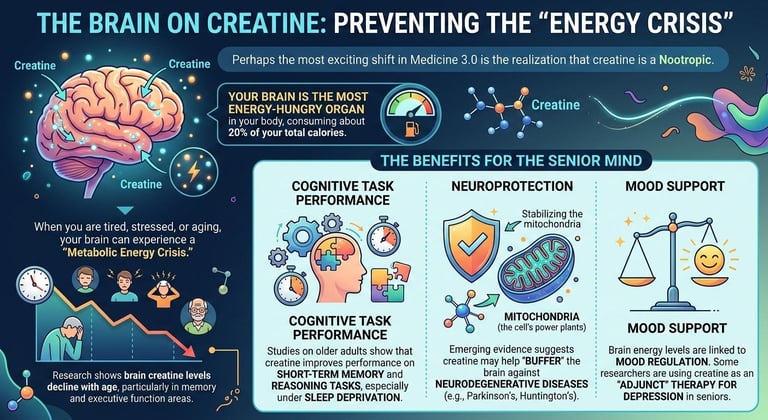
Perhaps the most exciting shift in Medicine 3.0 is the realization that creatine is a Nootropic. Your brain is the most energy-hungry organ in your body, consuming about 20% of your total calories.
When you are tired, stressed, or aging, your brain can experience a "Metabolic Energy Crisis." Research shows that brain creatine levels decline with age, particularly in areas associated with memory and executive function.
The Benefits for the Senior Mind:
Cognitive Task Performance: Studies on older adults show that creatine improves performance on short-term memory and reasoning tasks, especially under conditions of sleep deprivation.
Neuroprotection: There is emerging evidence that creatine may help "buffer" the brain against neurodegenerative diseases like Parkinson’s and Huntington’s by stabilizing the mitochondria (the cell's power plants).
Mood Support: Because brain energy levels are linked to mood regulation, some researchers are using creatine as an "adjunct" therapy for depression in seniors.
4. The Myth-Busting Corner: Is It Safe for Your Kidneys?
The most common reason seniors avoid creatine is the fear of kidney damage.
The Origin of the Myth: When you take creatine, your "Creatinine" levels (a waste product) might rise slightly on a blood test. In a sedentary person, high creatinine is a sign of kidney struggle. In a person taking creatine, it is simply a sign that the supplement is being processed.
The Reality: Extensive long-term studies have shown that in healthy individuals (even those with slightly reduced kidney function common in aging), a daily dose of 3 to 5 grams of creatine has zero negative impact on kidney health.
Evergold Rule: If you have active Stage 4 or 5 Kidney Disease, consult your nephrologist. For everyone else, the benefits of muscle preservation far outweigh the "marker" shift on a lab report.
5. The Evergold Protocol: How to Take It
For the 60+ biohacker, we don't need the "Loading Phases" (taking 20g a day) used by athletes. That often causes bloating and digestive upset. Instead, we use the "Slow and Steady" approach.
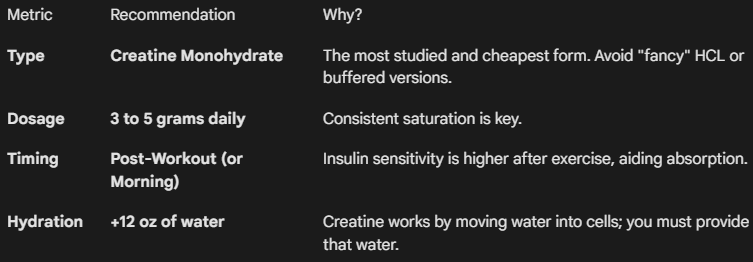
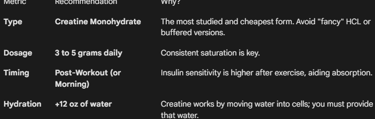
The "Evergold Hack": Stir your creatine into your morning coffee or a warm herbal tea. Modern "micronized" creatine monohydrate dissolves perfectly in warm liquids and has no taste.
6. The "Golden Trio" of Muscle Maintenance
Creatine is powerful, but it’s not a magic pill. To reach the Evergold Standard, you should combine it with:
Resistance Training: You must "signal" the muscles to grow. Creatine provides the fuel; you provide the stimulus.
Leucine-Rich Protein: Aim for 30g+ of protein per meal to trigger muscle protein synthesis.
Omega-3s: As we discussed in our last article, Omega-3s reduce the "anabolic resistance" that prevents seniors from building muscle.
Conclusion: Building Your "Reserve"
We don't buy insurance because we expect to crash the car tomorrow; we buy it so that we are protected if we do. Creatine is your Biological Insurance Policy. By maintaining your muscle mass and your brain’s energy stores, you are building a "Reserve" that will serve you for the next 20 or 30 years. It is one of the cheapest, safest, and most effective ways to ensure that your Marginal Decade is defined by "Doing" rather than "Declining."
So, put aside the 1990s myths. Creatine is a senior’s best friend.
Contact
© 2026. All rights reserved.
DISCLAIMER
We love sharing information, but please remember we aren't doctors, lawyers, or financial advisors. Always check in with a professional before you start a new fitness routine, change your diet, or make big financial decisions. Your specific situation deserves expert attention.