
Omega-3 Fatty Acids: The "Structural Oil Change" for Your Heart and Brain
In the framework of Medicine 3.0, we don't just look at Omega-3s as a "nice-to-have" supplement. Today, we’re looking at how to optimize your "Omega-3 Index" to protect your cognitive and cardiovascular reserve.
Evergold Longevity
3/5/20265 min read
Transparency Note: We use affiliate links on this page. If you decide to buy something through these links, we may earn a small commission. This helps us keep the site running and provides you with free content. Thank you for the support!
In the Evergold toolkit, we talk a lot about "molecular rust"—the oxidative stress and inflammation that slowly degrade our systems. If refined sugar is the fuel that accelerates that rust, then Omega-3 Fatty Acids are the high-grade synthetic oil that cleans, lubricates, and seals the engine.
As we move through our 60s and 70s, the composition of our cell membranes changes. They tend to become more rigid and less responsive. In the brain, this leads to slower processing; in the heart, it leads to electrical instability and "stiff" arteries.
In the framework of Medicine 3.0, we don't just look at Omega-3s as a "nice-to-have" supplement. We view them as essential structural components. You are quite literally made of what you eat. If you aren't consuming enough EPA and DHA, your body is forced to build your brain and heart out of inferior fats. Today, we’re looking at how to optimize your "Omega-3 Index" to protect your cognitive and cardiovascular reserve.
1. The Dynamic Duo: EPA vs. DHA
When you look at a bottle of fish oil, you’ll see two main acronyms: EPA (Eicosapentaenoic \ acid) and DHA (Docosahexaenoic \ acid). While they are often grouped together, they perform very different roles in the Evergold body.
EPA: The "Fire Extinguisher"
EPA is the primary anti-inflammatory powerhouse. It competes with Arachidonic Acid (an Omega-6 fat) to produce signaling molecules called eicosanoids.
The Benefit: EPA helps lower systemic inflammation, reduces triglycerides, and stabilizes the plaques in your arteries so they don't rupture.
DHA: The "Brain Architect"
DHA is the primary structural fat in the human brain and retina. It makes up about 20\% of the fat in your cerebral cortex.
The Benefit: DHA keeps cell membranes "fluid." This fluidity is essential for neurotransmitters like serotonin and dopamine to dock at their receptors. Without DHA, your brain cells are like a smartphone with a cracked, unresponsive screen.
2. The Brain Connection: Preventing Cognitive Decline
One of the most terrifying aspects of the Marginal Decade is the loss of "Executive Function." Recent neurology suggests that a significant portion of age-related brain shrinkage is actually a deficiency disease.
The "Type 3 Diabetes" Shield
As we’ve discussed, insulin resistance in the brain leads to neurodegeneration. Omega-3s improve the sensitivity of the insulin receptors in your neurons. Furthermore, DHA is essential for the Glymphatic System—the brain’s nightly "power wash" that removes Amyloid-beta and Tau proteins. High levels of Omega-3s ensure the "pipes" of this drainage system stay flexible and open.
Evergold Insight: A 2024 study showed that seniors with the highest Omega-3 levels had a hippocampus (the brain's memory center) that was structurally "years younger" than those with low levels.
3. The Heart Connection: Beyond Triglycerides
Medicine 2.0 focused almost exclusively on using fish oil to lower triglycerides. While it does that effectively, the Medicine 3.0 benefit is much deeper: Endothelial Function.
Your endothelium is the one-cell-thick lining of your entire vascular system. It’s responsible for "vasodilation"—the ability of your arteries to relax and let blood flow. Omega-3s increase the production of Nitric Oxide, keeping your pipes "rubbery" instead of "brittle."
The "REDUCE-IT" Protocol
Large-scale clinical trials (like REDUCE-IT) have shown that high-dose, purified EPA can reduce cardiovascular "events" (heart attacks and strokes) by up to 25\% in high-risk patients. For a senior biohacker, this is a more significant impact than many prescription statins.
4. The "Omega-3 Index": Your Most Important Bio-Metric
Most doctors never test your Omega-3 levels. At Evergold, we believe you cannot manage what you do not measure. We look at the Omega-3 Index—a blood test that measures the percentage of EPA and DHA in your red blood cell membranes.
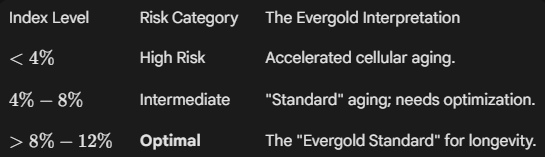
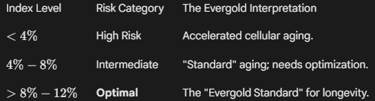
Why Red Blood Cells? Because red blood cells live for about 120 days, this test gives us a 3-month average of your "fatty acid status," rather than a temporary spike from your last meal.
5. The "Evergold" Dosing Protocol
For a 25-year-old, a single 1,000\text{ mg} capsule might be enough. For the 60+ generation, we are usually dealing with decades of "Omega-6" accumulation (from seed oils and processed foods). We need a higher "loading dose."
The Targets:
Dosage: Aim for 2,000\text{ mg} to 4,000\text{ mg} of combined EPA/DHA per day.
Note: Look at the "Supplement Facts," not the "Total Fish Oil." Many cheap brands claim 1,200\text{ mg} of fish oil but only contain 300\text{ mg} of actual Omega-3s.
Ratio: For brain support, look for a higher DHA ratio. For heart and joint support, look for higher EPA.
Timing & Absorption:
Omega-3s are fats. If you take them on an empty stomach, you will only absorb about 10\% - 20\%.
The Hack: Take your fish oil with your largest, highest-fat meal (like your Evergold Omelet) to trigger the release of bile and maximize absorption.
6. The "Rotten" Truth: Oxidation and Quality
This is where Gemini offers some unfiltered candor: Most fish oil on the shelf at your local big-box store is rancid.
Fish oil is highly unstable. When it sits in a warm warehouse or on a clear plastic bottle under fluorescent lights, it oxidizes. Consuming oxidized fish oil is actually pro-inflammatory—the exact opposite of our goal.
How to Audit Your Fish Oil:
The "Bite" Test: Bite into a capsule. It should taste mildly like fish, but not "foul" or "acidic." If it tastes like a garbage can at a pier, throw it away.
The TOTOX Score: Check the manufacturer’s website for their "Total Oxidation" score. It should be < 26.
Form: Look for the Triglyceride (TG) form rather than Ethyl Ester (EE). The TG form is 70\% more bioavailable.
7. The "SMASH" Strategy: Food First
While supplements are efficient, the Evergold generation should also prioritize the SMASH fish twice a week:
These small, cold-water fish are high in Omega-3s but low on the food chain, meaning they have minimal mercury and microplastic accumulation compared to Tuna or Swordfish.
Conclusion: Lubricating the Longevity Machine
You wouldn't drive a classic car 10,000 miles without checking the oil. Your body, after six decades of service, requires the same attention to detail.
By optimizing your Omega-3 Index to > 8%, you are doing more than just "taking a vitamin." You are reinforcing the structural integrity of every cell in your body. You are softening your arteries, sharpening your synapses, and cooling the fires of chronic inflammation. It is a simple, daily deposit into your Vitality Bank that pays dividends in clarity and strength for years to come.
Contact
© 2026. All rights reserved.
DISCLAIMER
We love sharing information, but please remember we aren't doctors, lawyers, or financial advisors. Always check in with a professional before you start a new fitness routine, change your diet, or make big financial decisions. Your specific situation deserves expert attention.