
Walking for Longevity: How Many Steps Do You Actually Need?
As we transition from the reactive model of Medicine 2.0 into the proactive, data-driven world of Medicine 3.0, we must ask: Is 10,000 steps a biological necessity, or a marketing masterstroke?
Evergold Longevity
3/24/20265 min read
Transparency Note: We use affiliate links on this page. If you decide to buy something through these links, we may earn a small commission. This helps us keep the site running and provides you with free content. Thank you for the support!
For the better part of three decades, the number "10,000" has been etched into the global consciousness as the definitive threshold for health. From wearable fitness trackers to corporate wellness challenges, this five-digit figure has become the gold standard for daily activity. But as we transition from the reactive model of Medicine 2.0 into the proactive, data-driven world of Medicine 3.0, we must ask: Is 10,000 steps a biological necessity, or a marketing masterstroke?
At EvergoldLongevity, we prioritize "Biological Capital." To build that capital, we need to move beyond arbitrary targets and understand the precise dose-reponse relationship between movement and mortality.
1. The 10,000 Step Myth: A Marketing Origin Story
In the mid-1960s, a Japanese company released a pedometer called the Manpo-kei. In Japanese, this translates literally to "10,000-step meter." There was no clinical trial, no longitudinal study, and no physiological data to support the number. It was chosen because the Japanese character for 10,000 (万) resembles a person walking, and it sounded like a formidable, yet achievable, goal for the post-war Japanese population.
While the Manpo-kei was a brilliant piece of marketing that encouraged millions to move, it inadvertently set a "fixed" target that science is only now beginning to refine. In the Medicine 2.0 world, 10,000 steps was the "prescription." In Medicine 3.0, we look for the Minimum Effective Dose and the Optimal Performance Ceiling.
2. The Science of the Curve: What the Data Actually Says
Recent high-fidelity studies using accelerometers (rather than self-reported data) have begun to map the true curve of walking’s impact on All-Cause Mortality (ACM).
The JAMA Findings
A landmark 2019 study published in JAMA Internal Medicine followed nearly 17,000 older women (average age 72). The findings were revolutionary for the longevity community:
The Baseline: Women averaging 2,700 steps per day had the highest mortality rates.
The First Threshold: At just 4,400 steps, mortality rates dropped significantly (by approximately 41%).
The Sweet Spot: The benefits continued to accrue in a linear fashion until approximately 7,500 steps.
The Plateau: Beyond 7,500 steps, the mortality curve flattened. There was no statistically significant advantage to walking 10,000 steps compared to 8,000 for the purpose of extending life.
The Lancet Public Health Meta-Analysis
A larger 2022 meta-analysis published in The Lancet Public Health analyzed data from nearly 50,000 people across four continents. It confirmed that for adults aged 60 and older, the risk of premature death leveled off at about 6,000 to 8,000 steps per day. For those younger than 60, the benefit plateaued closer to 8,000 to 10,000 steps.
The Evergold Takeaway: If your primary goal is the reduction of all-cause mortality, the "magic number" for the 60+ demographic is 7,500, not 10,000.
3. Medicine 3.0: Volume vs. Intensity
In the Medicine 3.0 framework popularized by experts like Dr. Peter Attia, we distinguish between Healthspan (quality of life) and Lifespan (length of life). While 7,500 steps might help you live longer, the way you take those steps determines how well you live.
The Problem with "Leisurely" Steps
If you walk 10,000 steps at a leisurely "window-shopping" pace, your heart rate likely remains in Zone 1. While this is superior to sedentary behavior, it lacks the cardiorespiratory stress required to improve VO2 max—the single greatest predictor of longevity.
A high VO2 max is not just for marathoners; it is the physiological buffer that allows a 90-year-old to climb a flight of stairs, carry groceries, or play with great-grandchildren without exhaustion.
The Power of Cadence
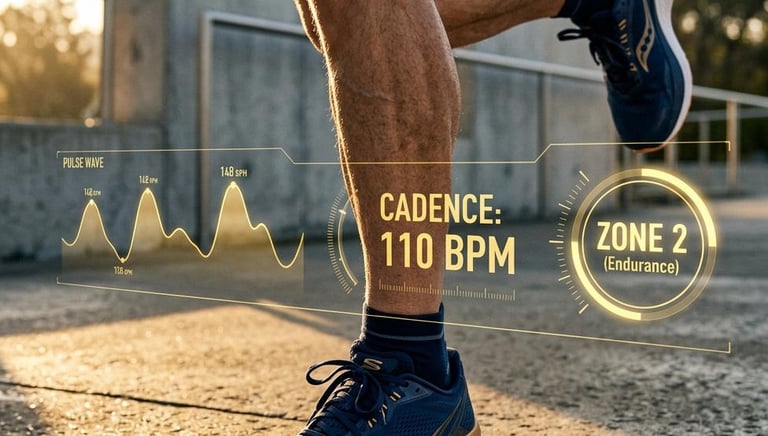
Research suggests that cadence (steps per minute) is a critical biomarker. A cadence of 100 steps per minute is considered "brisk" and usually pushes the average adult into Zone 2 training. Zone 2 is the "metabolic sweet spot" where you maximize mitochondrial fat oxidation and increase mitochondrial density.
At EvergoldLongevity, we teach that 3,000 brisk steps are biologically superior to 10,000 slow ones.
4. The "Second Heart": Walking and Metabolic Health
Skeletal muscle is often referred to as the body's "Second Heart" or its "Metabolic Sink." When you walk, particularly after a meal, your muscles act as a sponge for blood glucose.
Post-Prandial Glucose Blunting
One of the most effective Medicine 3.0 hacks is the "10-minute Post-Prandial Walk." Walking immediately after eating triggers the translocation of GLUT4 transporters to the cell surface, allowing your muscles to uptake glucose without a massive insulin spike.
The Benefit: Lower insulin levels mean less systemic inflammation and reduced risk of visceral fat accumulation—the "belly fat" that drives metabolic syndrome.
5. The Cognitive-Muscle Axis: Walking for Brain Health
We often view walking as a "below-the-neck" activity, but its most profound impact may be on the brain. Every time your foot strikes the pavement, your muscles release Myokines, specifically one called Irisin.
Irisin has the unique ability to cross the blood-brain barrier. Once in the brain, it stimulates the production of BDNF (Brain-Derived Neurotrophic Factor). BDNF is the primary driver of Neuroplasticity, facilitating the growth of new neurons in the hippocampus—the area of the brain most vulnerable to Alzheimer’s and age-related decline.
Evergold Insight: Walking in nature (the "Biophilia Effect") has been shown to amplify these cognitive benefits by lowering cortisol levels more effectively than treadmill walking.
6. Beyond Walking: The Case for Rucking
For the high-performing Evergold Athlete, standard walking eventually hits a ceiling of adaptive stress. To continue building Biological Capital, we must introduce Load.
This is why we advocate for Rucking—the simple act of walking with a weighted backpack.
Bone Mineral Density (BMD): Carrying weight provides the axial loading necessary to signal osteoblasts to build bone, a critical defense against osteoporosis.
The "Heart-Lung-Muscle" Trifecta: Rucking increases the metabolic cost of walking by 30-50%, turning a standard walk into a high-yield cardiorespiratory and strength session.
Functional Longevity: It builds the "posterior chain" (back, glutes, hamstrings), which is essential for maintaining an upright posture and preventing falls.
7. The Evergold Step Protocols: Tiered for Success
To apply this to your life, choose the tier that matches your current physiological standing:
Tier 1: The Foundations (The "Healthspan Starter")
Target: 5,000 to 7,000 total steps.
Constraint: At least three 10-minute walks per day, taken immediately after meals.
Focus: Glucose stability and consistency.
Tier 2: The Longevity Optimizer (The "Active Professional")
Target: 8,000 total steps.
Constraint: 3,000 of these steps must be at a "brisk" pace (>100 steps/min).
Focus: Zone 2 metabolic conditioning and VO2 max maintenance.
Tier 3: The Evergold Athlete (The "High-Performance Tier")
Target: 10,000 total steps + 2 Rucking sessions per week.
Constraint: Add 10-20% of your body weight to your pack for 30 minutes. Include hills or inclines.
Focus: Strength-endurance, bone density, and peak aerobic capacity.
Conclusion: Quality Over Quantity
In the era of Medicine 3.0, "more" is not always "better." Better is better.
The 10,000-step goal is a fine starting point for a sedentary population, but for those dedicated to the Evergold philosophy, we aim higher by training smarter. We track our cadence, we time our walks to our meals, we load our frames to build bone, and we use movement as a cognitive preservative.
Stop chasing an arbitrary number. Start building your biological legacy, one brisk, intentional step at a time.
Stay Strong. Stay Flexible. Stay Evergold.
Contact
© 2026. All rights reserved.
DISCLAIMER
We love sharing information, but please remember we aren't doctors, lawyers, or financial advisors. Always check in with a professional before you start a new fitness routine, change your diet, or make big financial decisions. Your specific situation deserves expert attention.