Vitamin D3 + K2: The Essential Duo for Bone and Heart Health
Taking Vitamin D and Calcium without their "partner" is like hiring a delivery driver who has the keys to the truck but no GPS. They have the cargo (Calcium), but they don't know where to put it.
Evergold Longevity
3/4/20264 min read
Transparency Note: We use affiliate links on this page. If you decide to buy something through these links, we may earn a small commission. This helps us keep the site running and provides you with free content. Thank you for the support!
In the Evergold community, we have a saying: "Structure is Destiny." If your skeletal structure fails, your independence fails. If your cardiovascular structure—your "pipes"—hardens, your longevity is cut short.
For years, the medical establishment told us the secret to strong bones was simple: Calcium + Vitamin D. But as we transition into the era of Medicine 3.0, we’ve discovered a dangerous flaw in that advice. Taking Vitamin D and Calcium without their "partner" is like hiring a delivery driver who has the keys to the truck but no GPS. They have the cargo (Calcium), but they don't know where to put it.
The result? The calcium ends up in your "pipes" (arteries) instead of your "safe" (bones). This is the Calcium Paradox, and the solution is the most essential duo in the biohacker’s cabinet: Vitamin D3 and Vitamin K2.
1. The Gatekeeper and the Traffic Cop
To understand this synergy, we have to look at the "Life Cycle of Calcium" in a mature body.
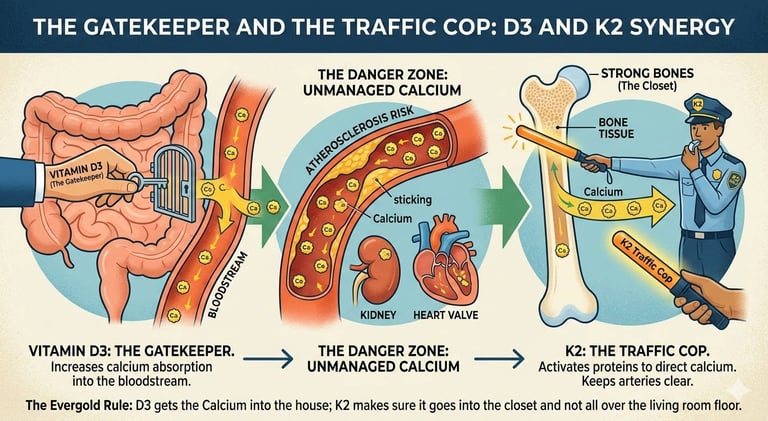
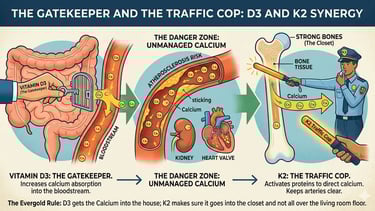
Vitamin D3: The Gatekeeper
Vitamin D3 (Cholecalciferol) is technically a pro-hormone, not a vitamin. Its primary job in the gut is to increase the absorption of calcium into the bloodstream. Without enough D3, you could swallow a mountain of calcium and it would simply pass through you.
Vitamin K2: The Traffic Cop
Once Vitamin D3 has pulled that calcium into your blood, you have a problem: Calcium is "sticky." If left to its own devices, it will settle in soft tissues—your heart valves, your kidney walls, and your arterial linings. This leads to Atherosclerosis (hardening of the arteries).
Vitamin K2 (specifically the MK-7 form) is the "Traffic Cop." It activates specific proteins that tell the calcium exactly where to go.
The Evergold Rule: D3 gets the Calcium into the house; K2 makes sure it goes into the closet and not all over the living room floor.
2. The Molecular Mechanism: MGP and Osteocalcin
How does K2 actually "talk" to calcium? It works through a process called Carboxylation. K2 activates two critical proteins:
Osteocalcin: This protein acts like "biological glue." Once activated by K2, it binds to calcium in the blood and "nails" it into the bone matrix.
Matrix Gla Protein (MGP): This is the most powerful inhibitor of soft-tissue calcification known to science. When K2 activates MGP, it effectively "scrubs" calcium out of your arteries.
If you have high Vitamin D but low Vitamin K2, you end up with a lot of inactive Osteocalcin and MGP. You have the tools, but nobody is using them. For a senior, this is the difference between a resilient hip and a calcified heart valve.
3. The "Calcium Paradox" and the Marginal Decade
As we enter our 60s and 70s, our risk of osteoporosis increases, but so does our risk of cardiovascular disease. The tragedy of Medicine 2.0 was that by treating the bones with high-dose calcium and Vitamin D alone, we were inadvertently increasing the risk of heart attacks.
A meta-analysis published in the British Medical Journal found that calcium supplements (without K2) were associated with a 30\% increased risk of myocardial infarction.
In the Evergold community, we don't accept "trade-offs." We want both. By pairing D3 with K2, you turn a potential cardiovascular risk into a skeletal benefit.
4. The Evergold Targets: How to Dose for Longevity
Most "Recommended Daily Allowances" (RDAs) are designed to prevent deficiency (like rickets or scurvy), not to optimize longevity. To reach the Evergold Standard, we look at higher, more precise targets.
The Vitamin D3 Target
We don't guess; we test. You should ask your doctor for a 25-hydroxy Vitamin D test.
Medicine 2.0 "Normal": 30 \text{ ng/mL}
Evergold Optimal: 50 - 80 \text{ ng/mL}
To reach this, most seniors require between 5,000$ and 10,000 \text{ IU} of D3 per day, depending on sun exposure and genetics.
The Vitamin K2 Target
There are two main forms of K2: MK-4 and MK-7.
MK-4: Found in animal products; has a short half-life (hours).
MK-7: Derived from fermented foods (like Natto); has a long half-life (days), meaning it stays in your blood longer to protect your arteries.
The Protocol: Look for a supplement with at least 180 \text{ mcg} of MK-7 for every 5,000 \text{ IU} of D3.
5. The "Magnesium Connection": The Third Wheel
There is one more player in this metabolic dance: Magnesium.
The enzymes that convert Vitamin D into its active form in the liver and kidneys are Magnesium-dependent. If you are magnesium deficient (which 70\% of seniors are), your Vitamin D3 will remain stored and inactive, no matter how much you take.
Evergold Hack: Take your D3+K2 with your largest meal (they are fat-soluble) and take a Magnesium Glycinate or Malate supplement in the evening.
6. Dietary Sources: Can You Eat Your Way to K2?
While D3 is "The Sunshine Vitamin," K2 is "The Fermentation Vitamin."
Natto: This fermented Japanese soy dish is the highest source of MK-7 on the planet. (Warning: The taste and texture are... an acquired taste).
Goose Liver Pate: High in MK-4.
Grass-Fed Butter and Egg Yolks: Contains K2, provided the animals were eating grass (which contains Vitamin K1 that they convert to K2).
Aged Cheeses: Gouda and Jarlsberg are surprisingly good sources of K2 due to the specific bacteria used in the ripening process.
7. Cautions and Contradictions
Because Vitamin K is involved in blood clotting, there is a major caution: Warfarin (Coumadin). If you are on traditional blood thinners, Vitamin K2 can interfere with the medication’s effectiveness. However, newer "DOAC" blood thinners (like Eliquis or Xarelto) do not typically have the same interaction.
Evergold Rule: If you are on any cardiovascular medication, always consult your cardiologist before starting K2. You aren't "just taking a vitamin"; you are altering your calcium signaling.
Conclusion: Securing Your Infrastructure
We are playing a long game. The goal of the Evergold lifestyle is to ensure that when you are 90, your bones are strong enough to support a vigorous walk, and your arteries are flexible enough to keep your brain perfectly oxygenated.
Vitamin D3 and K2 are the "Essential Duo" because they address the two biggest fears of aging: the fall and the "event." By directing calcium with precision, you are armoring your skeleton and softening your heart. It is the ultimate Medicine 3.0 insurance policy.
Contact
© 2026. All rights reserved.
DISCLAIMER
We love sharing information, but please remember we aren't doctors, lawyers, or financial advisors. Always check in with a professional before you start a new fitness routine, change your diet, or make big financial decisions. Your specific situation deserves expert attention.