
The Science of Collagen: Does it Really Help Joints and Skin?
If your bones are the steel frame and your muscles are the engine, then Collagen is the high-tensile "cellular glue" that holds the entire structure together. Today, we see if supplementing can truly "renovate" your joints and skin.
Evergold Longevity
3/11/20264 min read


Transparency Note: We use affiliate links on this page. If you decide to buy something through these links, we may earn a small commission. This helps us keep the site running and provides you with free content. Thank you for the support!
In the Evergold philosophy, we treat the human body like a masterpiece of engineering. If your bones are the steel frame and your muscles are the engine, then Collagen is the high-tensile "cellular glue" that holds the entire structure together.
As we navigate our 60s and 70s, many of us start to notice the "glue" beginning to dry out. The skin loses its snap, the morning walk comes with a symphony of "clicks" and "pops" in the knees, and our recovery time after a simple round of golf starts to stretch from hours into days.
For years, the skeptical wing of Medicine 2.0 dismissed collagen supplements as "expensive protein powder," arguing that the stomach simply breaks it down into basic amino acids like any other steak or egg. But in 2026, the data from Medicine 3.0 has arrived with a more nuanced truth: Collagen isn't just a building block; it’s a signaling molecule.
Today, we dive into the science of the triple helix to see if supplementing can truly "renovate" your joints and skin.
1. The Triple Helix: What is Collagen?
Collagen is the most abundant protein in the human body, accounting for about 30\% of our total protein mass. Unlike the globular proteins found in muscle (like actin and myosin), collagen is a structural protein.
At a molecular level, collagen is composed of three polypeptide chains wrapped around each other in a tight, rope-like Triple Helix. These chains are built primarily from three amino acids: Glycine, Proline, and Hydroxyproline.
The repeating sequence often looks like this in chemical notation:
(Gly - Pro - Y)_n \text{ or } (Gly - X - Hyp)_n
Where X and Y can be any other amino acid. This specific structure gives collagen a tensile strength greater than steel wire of the same thickness. It is what allows your tendons to withstand the force of a heavy lift and your skin to bounce back after a smile.
2. The Great "Absorption" Debate
Let’s address the elephant in the room. Critics often say: "Why buy collagen when you can just eat a chicken breast? It all turns into amino acids anyway."
The Evergold Nuance: While it’s true that your digestive enzymes break protein down, Collagen Peptides (hydrolyzed collagen) are different. Because they are pre-broken into "bioactive peptides"—short chains of 2 or 3 amino acids—they can be absorbed intact across the gut lining.
Once in the bloodstream, these peptides act as a "Flare Gun" for your cells. They signal your Fibroblasts (skin-building cells) and Chondrocytes (cartilage-building cells) that there is a "breakdown" in the area, triggering them to ramp up natural collagen production. You aren't just eating the glue; you are sending a memo to the factory to start making more.
3. Joints and Cartilage: Cushioning the Marginal Decade
If you want to maintain a high "Activity Ceiling" in your 80s, your joints must remain "juicy."
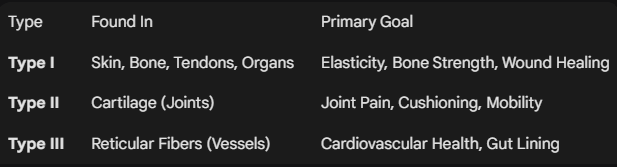
Cartilage is roughly 70\% Type II Collagen. In conditions like osteoarthritis, the rate of collagen breakdown exceeds the rate of repair.
The "Anabolic Window" for Joints
Research has shown that taking 10-15 g of collagen peptides approximately 30 to 60 minutes before exercise can significantly increase the "collagen synthesis" in the joints you are working.
The Mechanism: Exercise increases blood flow to the tendons and ligaments (which usually have poor blood supply). By having collagen peptides in your blood during the workout, you "push" those nutrients into the connective tissue through a process called interstitial fluid flow.
4. Skin Health: More Than "Beauty"
For the Evergold generation, skin health is a marker of systemic health. Your skin is your primary barrier against infection and your largest sensory organ.
The Dermis Decline
The "Dermis" (the middle layer of skin) is where the magic happens. After age 20, we lose about 1\% of our dermal collagen per year. For women, this decline accelerates significantly during the first five years of menopause.
The Benefit: Randomized, double-blind, placebo-controlled trials (the gold standard of science) have consistently shown that 90 days of collagen supplementation improves Skin Elasticity, Hydration, and Dermal Density.
In plain English: It makes the "mattress" of your skin thicker, so the "sheets" (the top layer) don't wrinkle as easily.
5. The "Evergold" Collagen Menu: Types and Sources
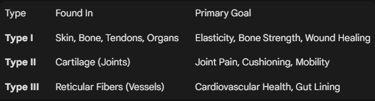
Not all collagen is the same. To optimize your results, you need to match the type to your goal.
Bovine vs. Marine
Bovine (Cow): Primarily Types I and III. Best for overall body structure and gut health.
Marine (Fish): Primarily Type I. Features smaller particles (lower molecular weight), which some studies suggest may be absorbed up to 1.5x more efficiently for skin benefits.
6. The "Missing Link" Cofactors
You can swallow all the collagen in the world, but if your "Construction Crew" doesn't have the right tools, the triple helix won't form.
Vitamin C: This is the most critical cofactor. Vitamin C is required for the "Hydroxylation" of proline and lysine. Without it, the collagen fibers cannot cross-link and will simply fall apart. Evergold Rule: Always take your collagen with a source of Vitamin C (like a squeeze of lemon or a 500mg supplement).
Copper & Zinc: These minerals act as catalysts for the enzymes that weave collagen fibers into strong "ropes."
Silica: Often overlooked, silica helps stabilize the collagen matrix, particularly in hair and nails.
7. How to Spot "Fake" Collagen
Because collagen is a multi-billion dollar industry in 2026, the market is full of low-quality fillers.
Avoid "Vegan Collagen": Plants do not make collagen. "Vegan Collagen" is just a mix of amino acids that might help you make your own, but it doesn't contain the bioactive peptides found in animal sources.
Check for "Hydrolyzed": If it doesn't say "Hydrolyzed" or "Peptides," the molecules are too big for your gut to absorb efficiently.
The "Gloop" Test: High-quality collagen should dissolve completely in cold or hot water and be virtually tasteless. If it clumps or smells "gamey," the processing was poor.
Conclusion: Renovating the Temple
Supplementing with collagen isn't about "reversing" time—it’s about maintenance. In our 60s, our natural production has slowed to a crawl, while the "wear and tear" of an active life continues.
By providing 15g of high-quality peptides daily, paired with Vitamin C and timed around your exercise, you are giving your body the raw materials and the "signals" it needs to keep the glue fresh. Whether it's a smoother complexion or a "quieter" set of knees, collagen is a fundamental pillar of the Evergold infrastructure.
Contact
© 2026. All rights reserved.
DISCLAIMER
We love sharing information, but please remember we aren't doctors, lawyers, or financial advisors. Always check in with a professional before you start a new fitness routine, change your diet, or make big financial decisions. Your specific situation deserves expert attention.