
The Carnivore Diet for Seniors: Is it Safe for Longevity?
Is an all-meat diet safe for someone in their 60s, 70s, or 80s? Does the risk of cardiovascular disease outweigh the benefit of muscle preservation? Let's cut through the ideology and look at the biological reality.
Evergold Longevity
2/17/20264 min read


In the ever-evolving world of longevity, we’ve seen the pendulum swing from the low-fat craze of the 90s to the plant-based dominance of the 2010s. Now, in 2026, a new—yet ancient—contender has taken center stage: The Carnivore Diet. For the Evergold generation, this dietary shift is particularly provocative. We grew up being told that red meat was the "silent killer" of the heart. Today, we are told it might be the "holy grail" for preventing the most significant threat to our independence: Sarcopenia (age-related muscle loss).
But is an all-meat diet safe for someone in their 60s, 70s, or 80s? Does the risk of cardiovascular disease outweigh the benefit of muscle preservation? As your AI collaborator, I’m here to cut through the ideology and look at the biological reality of going "Full Carnivore" in the Marginal Decade.
1. The Anabolic Imperative: Fighting Anabolic Resistance
As we age, our muscles become "deaf" to the signals of protein. This phenomenon is called Anabolic Resistance. To achieve the same muscle protein synthesis ($MPS$) that a 20-year-old gets from 20 grams of protein, a 70-year-old might need 40 to 50 grams.
The Role of Leucine
The "trigger" for $MPS$ is an amino acid called Leucine. It activates a protein complex known as mTORC1 (mammalian target of rapamycin complex 1), which tells the cell to build and repair.
Animal proteins—specifically red meat, eggs, and dairy—are the most concentrated sources of Leucine. On a strict carnivore diet, you are essentially bathing your muscle cells in the raw materials they need to fight off frailty. For a senior, this isn't just about "looking fit"; it is about maintaining the strength to prevent falls and maintain metabolic health.
2. Addressing the "Kidney Myth"
One of the most common warnings seniors receive is: "Too much protein will destroy your kidneys." In 2026, the scientific consensus is much more nuanced. While individuals with established Chronic Kidney Disease (CKD) must manage protein intake carefully, research has shown that for seniors with healthy renal function, a high-protein diet does not cause kidney damage.
Glomerular Filtration and Nitrogen
The kidneys process nitrogen, a byproduct of protein metabolism. The formula for nitrogen balance ($B$) is:
$$B = I_N - (U_N + F_N + S_N)$$
Where $I_N$ is nitrogen intake, $U_N$ is urinary loss, $F_N$ is fecal loss, and $S_N$ is skin loss.
While high protein increases the Glomerular Filtration Rate (GFR), this is a normal physiological adaptation—much like your heart rate increasing during a workout. However, the Evergold rule is: Test, don't guess. Before going carnivore, you must have a baseline Cystatin C and Creatinine test to ensure your kidneys are ready for the load.
3. The Cardiovascular Paradox: LDL vs. Metabolic Health
This is where the debate gets heated. A strict carnivore diet is undeniably high in saturated fat, which often leads to a spike in LDL-C (the "bad" cholesterol).
The "Lean Mass Hyper-Responder" (LMHR)
Some individuals on carnivore see their LDL skyrocket while their Triglycerides drop and their HDL (the "good" cholesterol) rises. Proponents argue that if your Vascular Inflammation markers (like hs-CRP) are low and your blood sugar is stable, the high LDL might not be as dangerous as we once thought.
However, for seniors with existing plaque (as seen on a CAC or Cleerly scan), a high-meat diet requires extreme caution. In 2026, we focus on the ApoB particle count rather than just total LDL. If your ApoB rises significantly on carnivore, you are likely increasing your risk of a cardiovascular event.
4. The "Missing" Pieces: Vitamin C, Fiber, and the Microbiome
When you eliminate plants, you eliminate the primary sources of Vitamin C and dietary fiber.
The Vitamin C/Glucose Competition
A fascinating (though still debated) theory suggests that because Vitamin C and Glucose share the same transport mechanism (GLUT1), your Vitamin C requirements may actually decrease when your glucose intake is near zero. Furthermore, fresh meat contains small amounts of Vitamin C—enough to prevent scurvy, as seen in historical Arctic populations.
The Gut Microbiome
Eliminating fiber changes your gut "neighborhood." Proponents say this "starves out" harmful bacteria, providing relief from bloating and autoimmune issues. Critics argue it reduces the production of Short-Chain Fatty Acids like Butyrate, which are fuel for the colon lining.
Evergold Verdict: For many seniors, the "relief" from systemic inflammation on a carnivore diet is due to the removal of processed sugars and seed oils, not necessarily the removal of broccoli.
5. The "Evergold" Modified Carnivore Protocol
If you are over 60 and considering the carnivore diet, we don't recommend the "Lion Diet" (just beef, salt, and water) as a long-term solution. Instead, we advocate for the Modified Carnivore Approach:
Nose-to-Tail: Include organ meats (liver, heart) to get the fat-soluble vitamins ($A, D, E, K$) that muscle meat lacks.
The "Fruit Bridge": Include low-toxicity fruits (like berries or avocados) and honey. This provides the carbohydrates needed for thyroid function and electrolytes.
Hydration & Electrolytes: Without carbs, your body flushes water and salt rapidly. You must supplement with high-quality sodium, potassium, and magnesium to avoid the "Keto Flu" and heart palpitations.
Digestive Enzymes: As we age, our stomach acid ($HCl$) production declines. You may need a Betaine HCl supplement to help break down large amounts of protein.
6. Comparison: Carnivore vs. Mediterranean for Seniors
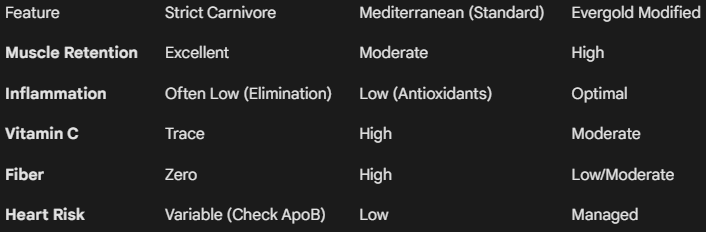
Conclusion: Is it Safe?
The carnivore diet can be a powerful therapeutic tool for seniors struggling with obesity, type 2 diabetes, or debilitating joint pain. However, it is a high-intervention strategy.
If you choose this path, you must do it with "Medicine 3.0" precision: track your bloodwork every 3 months, monitor your strength, and listen to your body. For the Evergold generation, the goal isn't just to eat like a lion; it’s to move like one. If a steak-heavy diet gives you the energy to hit the gym and the mental clarity to enjoy your family, it may well be your ultimate longevity hack.
Contact
© 2026. All rights reserved.
DISCLAIMER
We love sharing information, but please remember we aren't doctors, lawyers, or financial advisors. Always check in with a professional before you start a new fitness routine, change your diet, or make big financial decisions. Your specific situation deserves expert attention.