
The 2026 Guide to Bedroom Temperature for Longevity
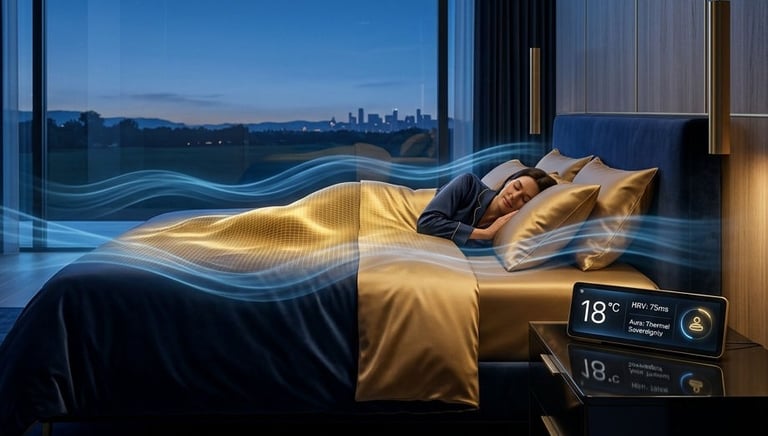
In 2026, we no longer guess our bedroom temperature; we engineer it to maximize the Biomarker Delta. If your bedroom environment isn't actively assisting your hypothalamus in lowering your core temperature, you are leaving years of cognitive and physical health on the table.
Evergold Longevity
4/20/20265 min read
Transparency Note: We use affiliate links on this page. If you decide to buy something through these links, we may earn a small commission. This helps us keep the site running and provides you with free content. Thank you for the support!
In the traditional wellness narrative, we are told to sleep in a "cool, dark room." While well-intentioned, this advice is the equivalent of telling a high-performance driver to "just use good fuel." It lacks the technical precision required for true Metabolic Recovery.
At EvergoldLongevity, we view sleep as the most critical biological intervention in the Medicine 3.0 toolkit. Specifically, we focus on the Thermal Dump—the process by which the body sheds core heat to initiate the repair cycles of the brain and heart. In 2026, we no longer guess our bedroom temperature; we engineer it to maximize the Biomarker Delta. If your bedroom environment isn't actively helping your hypothalamus lower your core temperature, you are leaving years of cognitive and physical health on the table.
1. The Biology of the Chill: Why the Hypothalamus Demands a Drop
Your body operates on a strict circadian rhythm dictated by light and, equally important, temperature. To initiate sleep, your core body temperature must drop by approximately 1°C to 1.5°C (2°F to 3°F).
This drop is managed by the Pre-Optic Area (POA) of the hypothalamus. Think of the POA as your biological thermostat. When the environment is too warm, the POA must work overtime to shunt blood to the skin (vasodilation) and activate sweat glands. This metabolic effort keeps your heart rate elevated and prevents your nervous system from transitioning from a sympathetic (alert) state to a parasympathetic (recovery) state.
For seniors over 60, this process is even more vital. As we age, our internal thermoregulation becomes slightly less efficient. By precisely controlling the bedroom temperature, we offload this metabolic work from the body, allowing those resources to be redirected toward Glymphatic Clearance and Protein Synthesis.
2. The "Goldilocks" Benchmark: 18°C (64.4°F)
Clinical research through 2025 and into early 2026 has established a definitive benchmark for optimal recovery: 18°C (64.4°F).
While this may feel "cold" to the uninitiated, it is the temperature at which the average human body can most easily achieve the required drop in core temperature without triggering a shivering response.
The Senior Adjustment
However, we practice precision, not generalizations. For the 60+ demographic, peripheral circulation (blood flow to the hands and feet) can vary. If the room is 18°C but your feet are freezing, your body will actually constrict blood vessels to keep heat in the core—effectively trapping the heat you are trying to shed. This is why the benchmark is the starting point, but the Micro-Climate is the solution.
3. The Recovery ROI: Deep Sleep vs. REM
Optimizing your temperature isn't just about "feeling comfortable." It is about the quality of your sleep architecture.
Deep Sleep (N3): This stage is highly sensitive to heat. If your body is struggling to stay cool, you will experience frequent "micro-arousals" that kick you out of Deep Sleep. This is where the brain flushes out amyloid-beta plaques. A room that is even 2°C too warm can reduce Deep Sleep by up to 20%.
REM Sleep: During REM, your body effectively loses its ability to thermoregulate. You become "poikilothermic" (like a reptile), taking on the temperature of your surroundings. If the room is too hot during the early morning hours (when REM is most frequent), your brain will wake you up to prevent overheating.
By maintaining thermal sovereignty, you ensure that these cycles remain uninterrupted, allowing for full cognitive and physical restoration.
4. Advanced Thermal Engineering: The 2026 Toolkit
In the Medicine 3.0 era, we move beyond the "open window" strategy. We utilize technology to create an active thermal environment.
I. Active Cooling Mattresses
Static foam mattresses are thermal traps; they absorb your body heat and radiate it back to you. The gold standard in 2026 is the Active Cooling Cover (such as the Eight Sleep Pod or similar clinical-grade systems). These systems circulate water through a thin grid, allowing you to set a precise temperature schedule.
The Evergold Protocol: Set the bed to "Cool" (approx. 20°C) 30 minutes before entry, drop to "Cold" (17°C) for the first 4 hours of sleep to anchor Deep Sleep, and gradually warm the bed to "Neutral" (22°C) in the hour before waking to assist with cortisol production.
II. High-Permeability Textiles
Your choice of linens is a critical part of the engineering.
Avoid: High-thread-count cotton or polyester, which traps heat.
Embrace: Tencel (Eucalyptus) or Bamboo fibers. These materials have superior moisture-wicking properties and higher thermal conductivity, meaning they move heat away from your skin faster than traditional fabrics.
5. The "Sock Paradox": Warm Feet for a Cold Core
It sounds counterintuitive, but one of the most effective ways to cool your core is to warm your feet.
Research in 2025 confirmed that wearing thin, breathable socks to bed (or using a localized foot-warmer) induces vasodilation in the extremities. This opens up the "radiators" of your body, allowing heat to escape through the soles of your feet. This rapid heat loss from the core to the periphery acts as a biological "fast-forward" for sleep onset.
6. Implementation: The 90-Minute Thermal Transition
To achieve thermal sovereignty, the intervention must begin before you even enter the bedroom.
The Hot Shower Hack: 90 minutes before bed, take a warm/hot shower. This causes blood to rush to the surface of your skin. When you step out into a cool room, your body experiences a rapid "radiator effect," causing your core temperature to plummet—perfectly timing your melatonin surge.
Room Pre-Cooling: If you do not have an active cooling mattress, your AC or fan should be engaged at least 60 minutes before bed. Entering a room that is already at 18°C provides a powerful psychological and biological signal that the "repair phase" has begun.
The "One-Foot" Method: If you feel a midnight "hot flash" or metabolic spike, simply sticking one foot out from under the covers can drop your core temperature in minutes due to the high density of specialized blood vessels (AVA) in the feet.
7. Auditing the Delta: Your 2026 Metrics
How do you know if your thermal optimization is working? You look at the data.
Heart Rate Variability (HRV): A cooler room almost universally leads to a higher nighttime HRV, indicating a dominant parasympathetic nervous system.
Resting Heart Rate (RHR): Your RHR should reach its "dip" (lowest point) in the first half of the night. If your RHR stays elevated until 4:00 AM, your room is likely too warm.
Sleep Efficiency: Look for a reduction in "awake time" during the night.
Conclusion: The New Luxury is Calibration
In the Evergold lifestyle, luxury is not defined by the softness of the pillow, but by the precision of the environment. Managing your bedroom temperature is a fundamental act of biological stewardship. By maintaining a cool environment and utilizing active thermal tools, you are ensuring that your brain and body have the "thermal space" required to perform the complex work of longevity.
Don't leave your recovery to the weather. Take control of your thermostat. Stay Sharp. Stay Cool. Stay Evergold.
Contact
© 2026. All rights reserved.
DISCLAIMER
We love sharing information, but please remember we aren't doctors, lawyers, or financial advisors. Always check in with a professional before you start a new fitness routine, change your diet, or make big financial decisions. Your specific situation deserves expert attention.