
Is Red Light Therapy Good For Joint Pain? Does the Science Hold Up?
The question for the longevity senior is no longer "Does it work?" but rather "How do we optimize the dosage to achieve structural joint repair?"
Evergold Longevity
5/4/20265 min read
Transparency Note: We use affiliate links on this page. If you decide to buy something through these links, we may earn a small commission. This helps us keep the site running and provides you with free content. Thank you for the support!
In the previous decade, Red Light Therapy (RLT) was often relegated to the peripheries of wellness—associated more with high-end spas and "biohacking" gadgets than with rigorous clinical intervention. However, as we move through 2026, the medical community has undergone a fundamental shift. Under the Medicine 3.0 framework, we no longer view light merely as a source of vision, but as a source of energy and signaling.
The question for the longevity senior is no longer "Does it work?" but rather "How do we optimize the dosage to achieve structural joint repair?" For those over 60, joint pain is rarely just a localized issue; it is a manifestation of systemic inflammation and mitochondrial decay. Photobiomodulation (PBM)—the technical term for RLT—offers a non-invasive way to intervene directly at the cellular level.
1. The Mechanism: How Photons Become Biology
The skepticism surrounding RLT often stems from a lack of understanding of the Photochemical Effect. Unlike a heating pad, which uses infrared to vibrate molecules (generating heat), RLT uses specific wavelengths of light to trigger a chemical change within the cell.
The Mitochondrial Engine
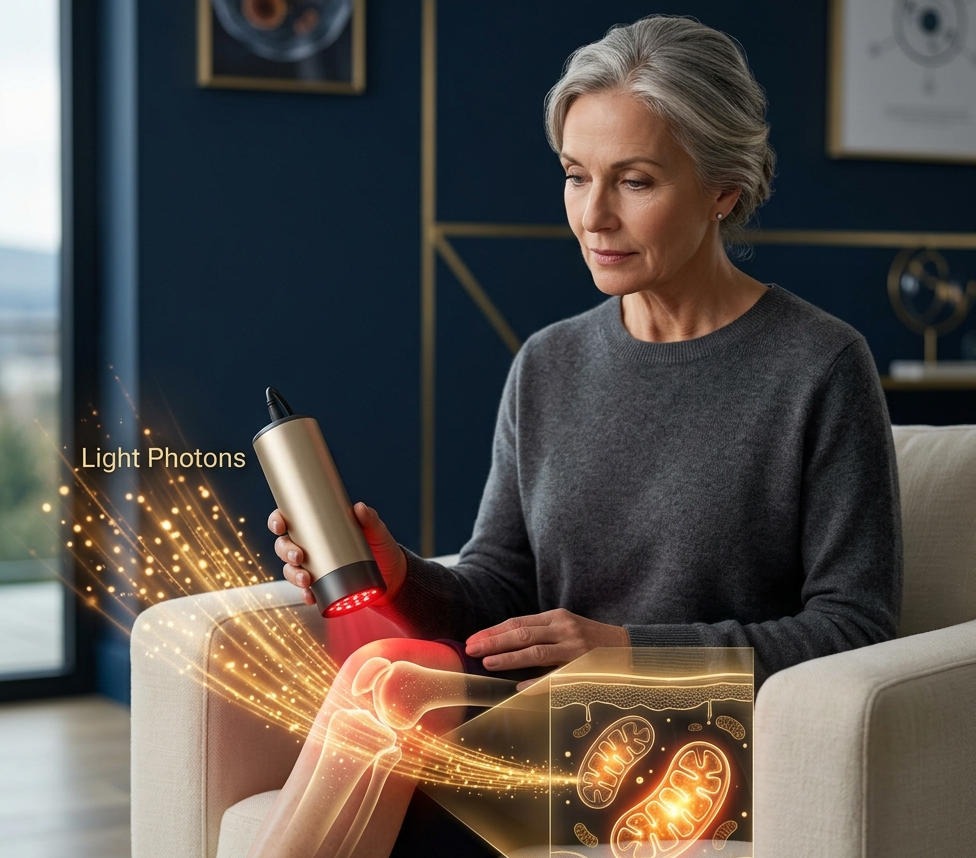
The primary target of RLT is an enzyme called Cytochrome c Oxidase, located within the mitochondria. This enzyme is a critical part of the electron transport chain that produces Adenosine Triphosphate (ATP)—the universal energy currency of your cells.
In an inflamed joint, the production of ATP is often hindered by the presence of Nitric Oxide (NO), which binds to Cytochrome c Oxidase and stalls the engine. Red and near-infrared light photons strike this enzyme and "kick off" the Nitric Oxide, allowing oxygen to rush back in and ATP production to resume.
For a senior, this means your chondrocytes (cartilage cells) and fibroblasts (tissue-repair cells) suddenly have the "metabolic budget" to begin repair work that was previously stalled by chronic inflammation.
2. The Wavelength Delta: 660nm vs. 850nm
In the 2026 Evergold protocol, we emphasize the distinction between Visible Red and Near-Infrared (NIR) light. They are not interchangeable.
Visible Red (660nm): These shorter wavelengths are absorbed primarily by the skin’s surface. They are excellent for wound healing and systemic anti-inflammatory signaling, but lack the "punch" to reach deep into a knee or hip joint.
Near-Infrared (850nm): These longer wavelengths have a "biological window" that allows them to penetrate up to 5–10 centimeters into the body. This is the wavelength required for Osteoarthritis (OA) and deep tissue recovery.
The 2026 Gold Standard
Recent meta-analyses from 2025 have shown that the most effective joint treatments utilize a synchronized pulse of both 660nm and 850nm. This creates a "dual-layer" effect: the 660nm light addresses the localized inflammation of the synovial fluid, while the 850nm light reaches the underlying bone and cartilage.
3. Joint-Specific Evidence: Does it Rebuild Cartilage?
One of the most persistent myths in Medicine 2.0 was that "cartilage cannot be repaired." While it is true that cartilage has a limited blood supply, the 2026 consensus is that it is metabolically active.
Osteoarthritis of the Knee
A landmark 2025 clinical trial followed 200 participants aged 60–75 with Grade II-III knee osteoarthritis. Participants received PBM three times a week for 12 weeks. The results showed:
A 35% reduction in pain scores (VAS).
A measurable increase in joint space width (as seen via high-resolution ultrasound), suggesting a reduction in the inflammatory "thinning" of the cartilage matrix.
Significant reduction in interleukin-1β (IL-1β), a pro-inflammatory cytokine that "eats" cartilage.
Rheumatoid and Systemic Inflammation
While RLT is a localized treatment, it has a "Systemic Carryover." When light hits the blood flowing through the capillaries near the joint, it modulates the activity of circulating white blood cells. This means that treating your knee may actually provide a minor anti-inflammatory benefit to your other joints—a phenomenon known as the Abscopal Effect.
4. The Arndt-Schulz Law: The Danger of "Over-Dosing"
In the Evergold philosophy, we respect the Biphasic Dose Response, also known as the Arndt-Schulz Law. More is not always better.
If you provide too little light, you get no biological response. If you provide the "sweet spot" (the peak of the curve), you get maximum regeneration. However, if you apply the light for too long or at too high an intensity, you can actually inhibit healing. This is where most consumer-grade "red light panels" fail; they don't provide the user with the precise Power Density (Irradiance) required to calculate an effective dose.
The Evergold Verdict: For joint pain, aim for a dose of 10–50 Joules per cm2 at the target tissue. Using a low-power device for an hour is not the same as using a high-fidelity, clinical-grade device for 10 minutes.
5. The 2026 Toolkit: Home vs. Clinical Devices
In 2026, the technology has bifurcated into two categories:
I. High-Irradiance Panels
Large panels (like the Joovv or Mito Red Pro series) are excellent for systemic health and larger joints like the back or hips. However, because the light scatters as it moves through the air, you must be positioned within 6–12 inches of the device to ensure the photons actually penetrate the joint capsule.
II. Targeted Laser Therapy (Class IV)
For severe joint degeneration, many seniors utilize Class IV Laser Therapy (Cold Laser). These devices use a coherent beam of light that can deliver a therapeutic dose deep into the hip or shoulder in a fraction of the time required by an LED panel.
III. Wearable Wraps
The "wearable" market has matured significantly. High-end wraps now include Pulsed Electromagnetic Field (PEMF) technology alongside RLT. The PEMF improves blood flow to the joint, which in turn increases the efficacy of the red light.
6. Implementation: Your 12-Week Joint Recovery Protocol
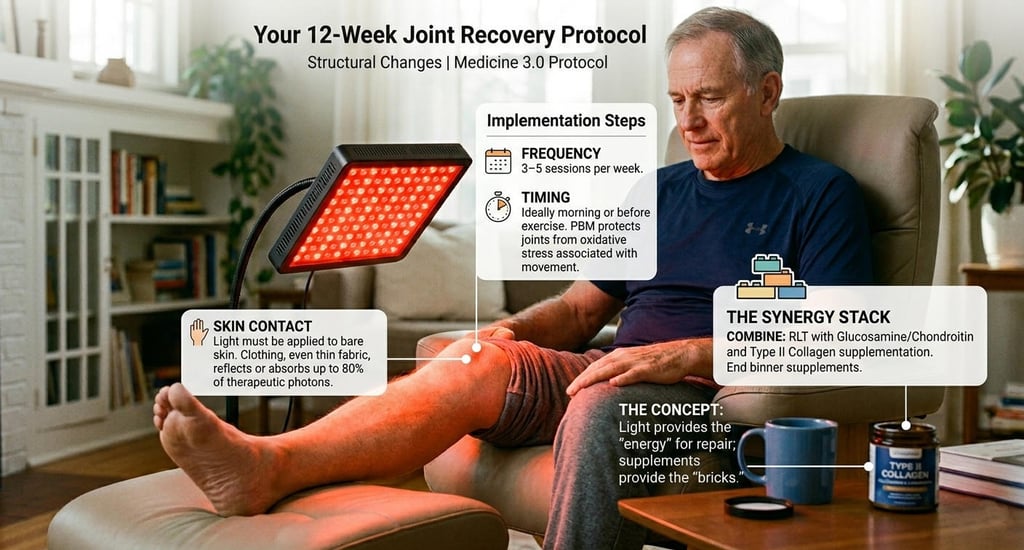
To see structural changes in joint health, you must move beyond sporadic use. We recommend the following Medicine 3.0 Protocol:
Frequency: 3–5 sessions per week.
Timing: Ideally, in the morning or before exercise. PBM has been shown to protect joints from oxidative stress associated with movement.
Skin Contact: Light must be applied to bare skin. Clothing, even thin fabric, reflects or absorbs up to 80% of the therapeutic photons.
The Synergy Stack: Combine RLT with Glucosamine/Chondroitin and Type II Collagen supplementation. The light provides the "energy" for the repair, while the supplements provide the "bricks."
Conclusion: A Tool of Precision, Not a Miracle
Red Light Therapy is not a "magic wand" that will instantly erase decades of joint wear. However, the science is now undeniable: it is a potent modulator of mitochondrial function and a fierce enemy of chronic inflammation.
In the Evergold era, we don't accept joint pain as a mandatory companion of age. We use every tool—from the molecular to the digital—to maintain our Structural Sovereignty. Red light therapy, when applied with the correct wavelength and dosage, is a cornerstone of that defense.
Stay Sharp. Stay Mobile. Stay Evergold.
Contact
© 2026. All rights reserved.
DISCLAIMER
We love sharing information, but please remember we aren't doctors, lawyers, or financial advisors. Always check in with a professional before you start a new fitness routine, change your diet, or make big financial decisions. Your specific situation deserves expert attention.