
Improving Joint Mobility: A Daily 10-Minute Protocol
Today, we are diving into a high-ROI, 10-minute daily protocol designed to lubricate your joints, wake up your nervous system, and reclaim the range of motion you thought was gone forever.
Evergold Longevity
3/19/20264 min read


Transparency Note: We use affiliate links on this page. If you decide to buy something through these links, we may earn a small commission. This helps us keep the site running and provides you with free content. Thank you for the support!
In the Evergold philosophy, we have a saying: “Your age isn't defined by the years on your birth certificate, but by the fluid movement of your spine and hips.” As we enter our 60s and 70s, many of us begin to accept a certain "stiffness" as an inevitable tax of time. We grunt when we tie our shoes, we turn our whole bodies instead of just our necks to check the blind spot while driving, and we find our world shrinking because our joints simply won’t "open up" like they used to.
In the framework of Medicine 3.0, we don't just want to be alive; we want to be biologically free. Mobility is the foundation of that freedom. It is the difference between "walking" and "striding." It is the difference between "sitting down" and "squatting with ease."
Today, we are moving past basic "touch your toes" stretching. We are diving into a high-ROI, 10-minute daily protocol designed to lubricate your joints, wake up your nervous system, and reclaim the range of motion you thought was gone forever.
1. The Science of the "Internal WD-40"
To understand mobility, we have to look at Synovial Fluid. Think of your joints like high-performance bearings in a vintage car. If the car sits in the garage for ten years, the oil gunkifies and the parts seize up.
Your joints don't have a dedicated pump like your heart. They rely on movement to circulate synovial fluid. This fluid provides nutrients to the cartilage and reduces friction. When you don't move a joint through its full range of motion, that fluid remains stagnant, and the joint capsule begins to "shrink-wrap" around the bone.
Mobility vs. Flexibility: The Evergold Distinction
Flexibility: The ability of a muscle to be stretched passively (like someone pushing your leg toward your head).
Mobility: The ability to move a joint actively through its full range of motion.
Medicine 3.0 Reality: Flexibility without strength is a recipe for injury. Mobility is "strength in range." It’s having the control to put your body where you want it to go.
2. The Protocol: The "Daily 10" (CARs)
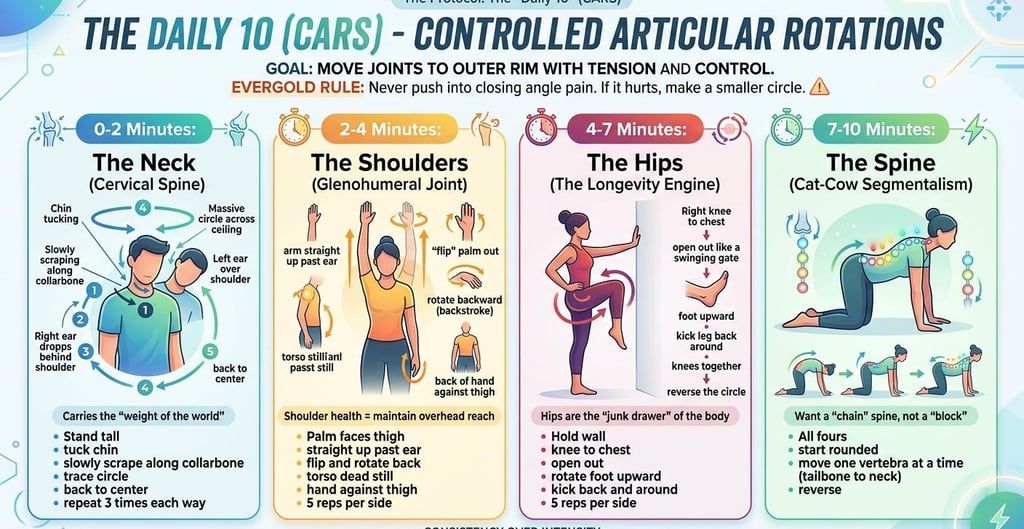
This protocol is based on CARs (Controlled Articular Rotations). The goal is to take each joint to its outermost "outer rim" with tension and control.
Evergold Rule: Never push into "closing angle" pain (sharp pain on the side of the joint you are moving toward). If it hurts, make a smaller circle.
0-2 Minutes: The Neck (Cervical Spine)
Most of us carry the "weight of the world" in our upper traps.
Stand tall, tuck your chin to your chest.
Slowly scrape your chin along your collarbone to the right shoulder.
Drop your right ear behind your right shoulder.
Trace a massive circle across the ceiling, ending with your left ear over the left shoulder.
Scrape back to center. Repeat 3 times each way.
2-4 Minutes: The Shoulders (Glenohumeral Joint)
Shoulder health is the key to maintaining overhead reach (grabbing that high shelf).
Stand with your palm facing your thigh.
Bring your arm straight up in front of you until it’s past your ear.
"Flip" your palm outward and rotate your arm backward as if you’re swimming the backstroke.
Keep your torso dead still; don't let your chest turn.
End with the back of your hand against your thigh. Repeat 5 times per side.
4-7 Minutes: The Hips (The Longevity Engine)
Hips are the "junk drawer" of the body—everything gets stuck there.
Hold onto a wall for balance.
Lift your right knee toward your chest.
Open the knee out to the side like a swinging gate.
Rotate your foot upward while keeping the knee still (this is the hard part).
Kick the leg back and around, ending with your knees together.
Reverse the circle. 5 reps per side.
7-10 Minutes: The Spine (Cat-Cow Segmentalism)
We don't want a "block" of a spine; we want a "chain."
On all fours, start in a rounded position (Cat).
Instead of just "flipping" to Cow, try to move one vertebra at a time.
Start at your tailbone. Tilt it up. Then move the next bone... then the next... all the way up to your neck.
Then reverse it from the neck down.
3. The "Use It or Lose It" Neurological Loop
Why do we do this every day? Because your brain is an efficiency expert. If you haven't used the last 15° of your shoulder's rotation in six months, your brain decides that space is "dangerous" or "unnecessary." It literally sends a signal to tighten the surrounding tissues to prevent you from going there.
By performing these rotations daily, you are sending a "Safety Signal" to your nervous system. You are telling your brain, "I still own this territory."
4. The Equipment: Less is More
The beauty of the Evergold Mobility Protocol is that it requires zero fancy gadgets. However, to optimize your results, we suggest:
The Wall: Your best friend for balance and ensuring you aren't "cheating" by twisting your spine.
A Tennis Ball: If you find a "sticky" spot, you can use a ball to provide some myofascial release (SMR) before starting your rotations.
A Yoga Block: To sit on if your hips are too tight to sit comfortably on the floor.
5. Timing: When to "Oil the Hinges"
The best time to do your 10 minutes is first thing in the morning. After 8 hours of being a "human statue" in bed, your tissues are at their most dehydrated and stiff.
Evergold Pro-Tip: Do your CARs while your coffee is brewing. By the time the cup is poured, your nervous system is awake, your joints are lubricated, and you’ve already won the morning.
Conclusion: The Maintenance of the Masterpiece
You wouldn't expect a million-dollar car to run forever without oil changes. Your body is the only vehicle you’ll ever truly own—treat it with the same respect.
Ten minutes sounds like a small investment, but over a year, that’s 60 hours of intentional joint maintenance. It’s the difference between a 90-year-old who can still reach their own toes and one who is "locked" in their own frame.
Reclaim your territory. Move your joints. Stay Evergold.
Contact
© 2026. All rights reserved.
DISCLAIMER
We love sharing information, but please remember we aren't doctors, lawyers, or financial advisors. Always check in with a professional before you start a new fitness routine, change your diet, or make big financial decisions. Your specific situation deserves expert attention.