
How to Improve Muscle Mass After 60: The Resistance Training Guide
In the Evergold philosophy, we have a sobering but empowering truth: After the age of 60, your muscle mass is no longer a given—it is a choice. Today, we’re breaking down the science of rebuilding your physical architecture.
Evergold Longevity
3/16/20264 min read

Transparency Note: We use affiliate links on this page. If you decide to buy something through these links, we may earn a small commission. This helps us keep the site running and provides you with free content. Thank you for the support!
In the Evergold philosophy, we have a sobering but empowering truth: After the age of 60, your muscle mass is no longer a given—it is a choice.
If you do nothing, biology will decide for you. Through a process called Sarcopenia, the average person loses about 3-8% of their muscle mass per decade after age 30, a rate that accelerates significantly once you cross the 60-year mark. This isn't just about how you look in a swimsuit; it’s about your "Life Currency." Muscle is the armor that protects your bones during a fall, the engine that drives your metabolic health, and the primary predictor of how much independence you will have in your 80s and 90s.
In the framework of Medicine 3.0, we move away from the "don't overdo it" advice of the past. Instead, we embrace Resistance Training as a clinical intervention. Today, we’re breaking down the science of rebuilding your physical architecture, because it is never too late to tell your body that it still needs to be strong.
1. The Science of "Anabolic Resistance"
To build muscle after 60, we have to fight a phenomenon called Anabolic Resistance. In our 20s, looking at a dumbbell was almost enough to trigger muscle growth. Our bodies were highly sensitive to protein and exercise.
As we age, the "switch" that turns on muscle protein synthesis—a protein complex called mTOR (mammalian target of rapamycin)—becomes harder to flip.
To overcome this resistance, we need two things: greater mechanical tension (heavier weights) and higher protein boluses (more leucine). We cannot "walk" our way to muscle mass. Walking is great for Zone 2 cardio, but for muscle, we need to move load.
2. The Evergold Resistance Framework: The Three Pillars
We don't train like 20-year-old bodybuilders. We train for Functional Longevity. This means prioritizing movements that correlate with a lower risk of all-cause mortality.
Pillar 1: Mechanical Tension (The "Heavy" Factor)
You must lift weights that are challenging. If you can easily perform 20 repetitions of an exercise, the weight is too light to overcome anabolic resistance. We aim for the "Golden Range" of 8 to 12 repetitions, where the last two reps feel significantly difficult.
Pillar 2: Progressive Overload
Your body is an adaptive machine. If you lift the same 10lb dumbbells for three years, your body has no reason to grow. You must gradually increase the "stress" by:
Adding more weight (+2.5-5lbs).
Adding more repetitions.
Decreasing rest time between sets.
Pillar 3: Frequency and Volume
For seniors, the "Sweet Spot" is 3 full-body sessions per week. This allows for 48 hours of recovery—essential because our "Repair Windows" are slightly longer than they used to be.
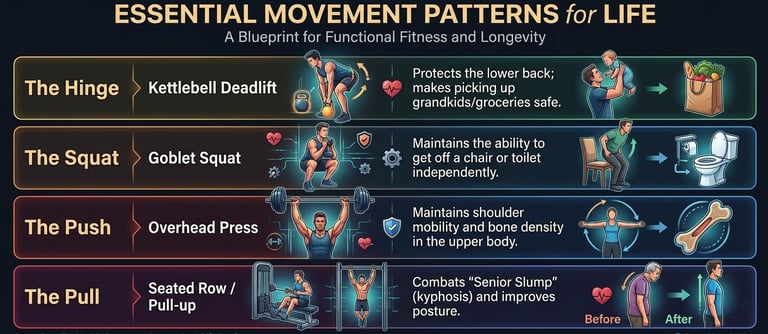
3. The "Big Four" Movements for Longevity
If you only have 30 minutes, focus on these four movement patterns. They are the highest-ROI (Return on Investment) exercises for the aging body.
4. Grip Strength: The Longevity "Crystal Ball"
In Medicine 3.0, we view Grip Strength as a vital sign, right next to blood pressure. There is a direct statistical correlation between low grip strength and an increased risk of cognitive decline and cardiovascular disease.
The Evergold Hack: Incorporate "Farmer’s Carries." Pick up two heavy dumbbells or kettlebells and walk for 40 meters. It builds core stability, traps, and—most importantly—crushing grip strength.
5. The Recovery Equation: Protein and Sleep
You don't build muscle in the gym; you build it while you sleep. Resistance training creates microscopic tears in the muscle fibers. The repair of these tears is what makes the muscle larger and stronger.
The Leucine Trigger
To repair those fibers, you need amino acids, specifically Leucine.
The Goal: Aim for 1.2-1.6 grams of protein per kilogram of body weight.
The Timing: For seniors, it is better to have three "large" hits of protein (30-40-g) rather than grazing on small amounts throughout the day. You need that 30g threshold to "flip the switch" on muscle protein synthesis.
6. Safety: Managing the "Wear and Tear"
"I’m too old for that" is usually a fear of injury. To stay in the game, follow these safety protocols:
The 10-Minute Warm-up: Spend ten minutes increasing your core temperature with light cardio and dynamic stretching. Cold tendons are brittle tendons.
Form Over Ego: A "Medicine 3.0" athlete never sacrifices form for weight. If your back rounds during a deadlift, the set is over.
Joint-Friendly Variations: If standard squats hurt your knees, try Box Squats. If overhead pressing bothers your shoulders, use a Landmine Press. There is always a version that works for your anatomy.
Conclusion: Investing in Your Future Self
Think of resistance training as a high-yield savings account. Every rep is a deposit. When you hit age 85, you are going to need to "withdraw" some strength to recover from a flu or a minor trip. If your account is empty, the consequences are dire. If it’s full, you’ll bounce back.
Building muscle after 60 isn't about vanity—though looking better in your clothes is a nice side effect. It’s about freedom. It’s about being the person who can still carry their own luggage, hike the trail, and stand tall.
Start today. Pick up something heavy. Your 80-year-old self is already thanking you.
Contact
© 2026. All rights reserved.
DISCLAIMER
We love sharing information, but please remember we aren't doctors, lawyers, or financial advisors. Always check in with a professional before you start a new fitness routine, change your diet, or make big financial decisions. Your specific situation deserves expert attention.