
Gut Health and Aging: Why Your Microbiome Changes After Retirement
The gut microbiome doesn't just age alongside us; it can actually accelerate or decelerate the aging process itself. You need to understand why your gut changes after retirement and how to "re-wild" your inner ecosystem for longevity.
Evergold Longevity
2/25/20264 min read


Transparency Note: We use affiliate links on this page. If you decide to buy something through these links, we may earn a small commission. This helps us keep the site running and provides you with free content. Thank you for the support!
In the Evergold philosophy, retirement isn't just a change in your tax bracket—it’s a seismic shift in your biological landscape. We often talk about the "Marginal Decade" in terms of heart health and muscle mass, but there is an invisible ecosystem that dictates the quality of those years: The Microbiome.
For forty years, your gut bacteria operated under the "Command and Control" of your working life. You had a routine, a specific coffee brand, a predictable lunch hour, and a certain level of daily movement. When you retire, that structure disappears. Suddenly, your internal "garden" is subject to a new climate.
The science of Medicine 3.0 has revealed that the gut microbiome doesn't just age alongside us; it can actually accelerate or decelerate the aging process itself. If you want to remain the "Chief Health Officer" of your life, you need to understand why your gut changes after retirement and how to "re-wild" your inner ecosystem for longevity.
1. The Microbial "Retirement Shift": What Happens Inside?
As we cross the threshold of 60, our microbiome undergoes a natural transition often referred to as microbial senescence. Diversity, the "Golden Metric" of gut health, tends to decline.
In a younger gut, you have a sprawling metropolis of thousands of bacterial species. In an aging gut, particularly post-retirement, this metropolis can turn into a "ghost town" dominated by a few hardy, and sometimes inflammatory, species.
The Loss of the "Peacekeepers"
Specifically, we see a decrease in Bifidobacterium and Akkermansia muciniphila. These are the "peacekeepers" that maintain the integrity of your gut lining. When they disappear, the barrier between your gut and your bloodstream becomes porous—a condition known as "Leaky Gut" or increased intestinal permeability.
When toxins (Lipopolysaccharides or LPS) leak into your system, they trigger a state of chronic, low-grade inflammation that scientists call "Inflammaging." This is the silent driver of joint pain, brain fog, and cardiovascular decline in your 60s and 70s.
2. Why Retirement is a "Stress Test" for the Gut
Why does retirement, specifically, trigger this change? It’s rarely about age alone; it’s about the lifestyle drift that follows the gold watch ceremony.
A. The "Vacation Diet" Trap
In retirement, every day can feel like a Saturday. We eat out more, we indulge in "treats" more frequently, and we often lower our fiber intake in favor of softer, processed "comfort" foods. Refined sugars and seed oils act like "weed-killer" for your beneficial bacteria, allowing pro-inflammatory species to flourish.
B. The Circadian Disruption
Our gut bacteria have their own "internal clocks." They expect to be fed and to rest at specific times. When retirement eliminates your 7:00 AM breakfast and 12:00 PM lunch routine, your microbiome becomes "jet-lagged." This disruption impairs the production of Short-Chain Fatty Acids (SCFAs) like $Butyrate$, which are the primary fuel for your colon cells.
C. The Medication Cascade
By age 65, the average person is on five or more medications. NSAIDs (for joint pain), Proton Pump Inhibitors (for acid reflux), and frequent antibiotics are "scorched earth" policies for the gut. They don't just kill the "bad" bugs; they wipe out the very species you need for longevity.
3. The Gut-Brain Axis: Protecting Your Cognitive Reserve
One of the most profound realizations in modern longevity science is that the gut is the "Second Brain." They are connected by the Vagus Nerve, a bidirectional superhighway.
Your gut bacteria produce roughly 90-95% of your body's Serotonin and a significant portion of your GABA (the "calm-down" neurotransmitter).
The Retirement Risk: If your microbiome becomes imbalanced (Dysbiosis), your production of these neuro-chemicals drops. This isn't just a mood issue; it’s a cognitive one.
Type 3 Diabetes: As we discussed in our "Refined Sugar" article, a leaky gut leads to systemic inflammation that can cross the blood-brain barrier, contributing to insulin resistance in the brain.
In the Evergold community, we don't just "do crosswords" for brain health. We eat fermented cabbage.
4. The Microbiome-Muscle Connection (The "Gut-Muscle Axis")
We spent last month talking about Sarcopenia (muscle loss). But here is the "Evergold Secret": you can eat all the protein in the world, but if your gut bacteria aren't healthy, you can't utilize it.
A healthy microbiome helps break down proteins into bioavailable amino acids. Furthermore, certain bacteria produce metabolites that actually signal your muscles to grow. A study on "Super-Agers" (people over 80 with the vitality of 50-year-olds) found they had significantly higher levels of certain gut bacteria that promote physical strength.
5. The Evergold Gut Protocol: "Re-Wilding" After 60
If you want to reverse microbial aging, you have to treat your gut like a high-end botanical garden. Here is the 4-step protocol for the retired biohacker.
Step 1: The "30 Plants a Week" Challenge
Diversity in your diet equals diversity in your gut. Aim for 30 different plant types per week. This sounds daunting, but it includes herbs, spices, nuts, seeds, and different colored vegetables.
Why? Different plants contain different Polyphenols, which act as targeted "fertilizers" for specific beneficial bacteria.
Step 2: The "Fermented Frontier"
Instead of a sugar-laden yogurt, turn to the "Traditional Four":
Kefir: (A fermented milk drink with up to 30 strains of probiotics).
Sauerkraut: (Raw, unpasteurized).
Kimchi: (For a metabolic and microbial boost).
Kombucha: (Low-sugar versions only).
Step 3: Targeted Prebiotics (Feeding the "Good Guys")
Prebiotics are the non-digestible fibers that your bacteria eat. To boost your $Akkermansia$ (the gut lining protector), focus on:
Pomegranate/Berries: (Rich in Ellagitannins).
Jerusalem Artichokes: (Inulin).
Cold Potatoes/Rice: (Resistant Starch).
Step 4: The "Stool Audit"
In the Evergold world, we don't guess. We test. Once a year, consider a high-resolution stool test (like GI-Map or Viome). This will tell you exactly which "peacekeepers" are missing and whether you have any "opportunistic" pathogens (like H. pylori or Candida) that are stealing your energy.
6. The "Evergold" Summary of Gut Health
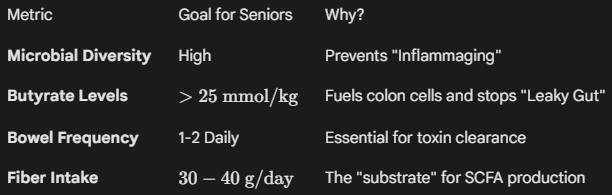
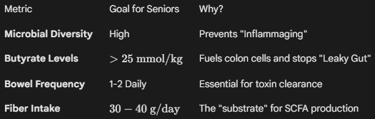
Conclusion: Being the CEO of Your Inner Ecosystem
Retirement should be the era where you have the time to focus on the things that truly matter. Your microbiome is the foundation of your energy, your mood, and your physical independence.
Don't let your inner garden go to seed just because the office routine ended. By feeding your "Good Bugs," staying hydrated, and maintaining a "Medicine 3.0" testing schedule, you ensure that your gut remains as vibrant and resilient as your spirit. Your microbiome doesn't have to age—it just needs a new, better manager.
Contact
© 2026. All rights reserved.
DISCLAIMER
We love sharing information, but please remember we aren't doctors, lawyers, or financial advisors. Always check in with a professional before you start a new fitness routine, change your diet, or make big financial decisions. Your specific situation deserves expert attention.