CoQ10 and Statins: What Every Retiree Needs to Know
Today, we are exploring the critical relationship between Statins and Coenzyme Q10 (CoQ10)—and why understanding this duo is essential for protecting your vitality after 60.
Evergold Longevity
3/10/20265 min read


Transparency Note: We use affiliate links on this page. If you decide to buy something through these links, we may earn a small commission. This helps us keep the site running and provides you with free content. Thank you for the support!
In the Evergold community, we view cardiovascular health as the literal "infrastructure" of longevity. If the pipes are clear and the pump is strong, the rest of the system—the brain, the muscles, the metabolic engine—can thrive. For millions of retirees, the cornerstone of this infrastructure is the statin.
Statins (HMG-CoA reductase inhibitors) are arguably the most successful class of drugs in medical history. They have saved countless lives by lowering $LDL$ cholesterol and reducing arterial inflammation. However, in the world of Medicine 3.0, we don't just ask if a drug "works"; we ask what the biological cost of that drug is.
If you are a senior taking a statin, you may have noticed a subtle "dimming" of your energy, or perhaps a persistent ache in your calves that wasn't there five years ago. This isn't necessarily "just getting older." It is likely the result of a predictable biochemical trade-off. Today, we are exploring the critical relationship between Statins and Coenzyme Q10 (CoQ10)—and why understanding this duo is essential for protecting your vitality after 60.
1. The Mevalonate Factory: Why Statins are a Double-Edged Sword
To understand the conflict, we have to look at the "factory" inside your liver cells. Statins work by inhibiting an enzyme called HMG-CoA reductase. This enzyme is the "Master Foreman" of a metabolic assembly line called the Mevalonate Pathway.
The primary goal of this factory is to produce Cholesterol. By slowing down the foreman, statins effectively lower the amount of cholesterol entering your bloodstream. This is the "Win."
The Problem: The Mevalonate Pathway doesn't just make cholesterol. It is a multi-purpose factory. One of its other major "products" is Coenzyme Q10. When you tell the foreman to slow down the line to stop making cholesterol, you inadvertently slow down the production of CoQ10 as well.
Research shows that statin therapy can deplete your natural CoQ10 levels by as much as 40\%. For a 70-year-old whose CoQ10 production was already naturally declining, this can push the body into a "cellular energy crisis."
2. CoQ10: The Heart’s Spark Plug
What exactly does CoQ10 do? Think of it as the "spark plug" in your cellular engine. It resides inside your Mitochondria—the power plants that generate ATP (Adenosine \ Triphosphate), the universal currency of energy.
Within the mitochondrial membrane, CoQ10 acts as an electron shuttle. It carries high-energy electrons from one complex to another. If there isn't enough CoQ10, the "shuttle" stops, the assembly line breaks down, and ATP production stalls.
Because your heart and brain are the most energy-hungry organs in your body, they contain the highest concentrations of mitochondria. When CoQ10 levels drop, these organs are the first to feel the "flicker" in the power grid.
3. SAMS: Decoding Statin-Associated Muscle Symptoms
The most common reason retirees stop taking their prescribed statins is a condition known as SAMS (Statin-Associated Muscle Symptoms). It manifests as:
Myalgia: Dull, heavy aching in the large muscles (thighs, back, arms).
Weakness: A sudden inability to perform the same number of reps in the gym or walk the same distance.
Fatigue: A general sense of being "drained" despite adequate sleep.
For years, many physicians dismissed these symptoms as "placebo" or "nocebo" effects. However, recent biopsies of muscle tissue in statin users often show clear evidence of mitochondrial dysfunction. By depleting CoQ10, statins may be "starving" your muscle cells of the energy they need to repair and contract.
In the Evergold philosophy, we believe you shouldn't have to choose between a healthy heart and the ability to walk. Supplementing with CoQ10 is the "bridge" that allows the statin to do its job while keeping the muscle mitochondria fueled.
4. Ubiquinone vs. Ubiquinol: The Evergold Choice
If you walk into a pharmacy in 2026, you will see two forms of CoQ10. For a senior, the choice you make here is the difference between a wasted supplement and a life-changing one.
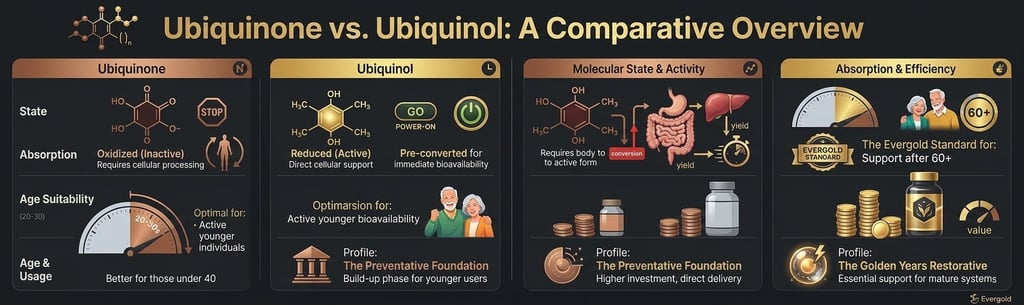
The Science of Aging: As we age, our bodies lose the ability to convert the cheap form (Ubiquinone) into the active form (Ubiquinol). Studies show that in seniors, Ubiquinol can be up to 8 times more bioavailable.
Evergold Rule: If you are over 60, don't waste your money on Ubiquinone. Your body likely can't "unlock" it. Look for "Kaneka Quality" Ubiquinol on the label.
5. The Heart Failure Connection
While statins are used to prevent heart attacks, we must also consider Heart Failure—a condition where the heart muscle becomes too weak to pump effectively.
The landmark Q-SYMBIO study showed that patients with moderate-to-severe heart failure who supplemented with CoQ10 had a 43\% reduction in major cardiovascular events and a significant improvement in symptoms.
Even if you don't have heart failure, maintaining high CoQ10 levels ensures that your heart muscle remains "energetically resilient." If a statin is part of your longevity plan, CoQ10 should be its mandatory partner.
6. The "Evergold" Protocol: Dosage and Timing
To reach the Evergold Standard, we don't just pop a pill; we optimize the delivery.
The Dose
Standard Support: 100-200 mg of Ubiquinol daily.
If you have SAMS (Muscle Pain): Many practitioners recommend increasing to 400 mg daily for 30 days to "load" the system, then tapering back.
The Delivery
CoQ10 is highly fat-soluble. If you take it on an empty stomach with just water, most of it will end up in the toilet.
The Hack: Take your Ubiquinol with your largest meal of the day—ideally one that includes healthy fats like avocado, extra virgin olive oil, or grass-fed butter.
The Synergy
For the ultimate mitochondrial "power-up," many Evergold members pair CoQ10 with PQQ (Pyrroloquinoline \ quinone). While CoQ10 helps the mitochondria work better, PQQ has been shown to stimulate Mitochondrial Biogenesis—the creation of new mitochondria.
7. Cautions: The Blood Thinner Rule
As always, we prioritize safety. Because CoQ10 is chemically similar to Vitamin K, it can occasionally interfere with the blood-thinning medication Warfarin (Coumadin).
The Strategy: If you are on Warfarin, do not start CoQ10 without your doctor’s supervision. They will likely need to monitor your INR (clotting time) more closely for the first two weeks. If you are on newer thinners like Eliquis, this interaction is much less common, but a conversation with your cardiologist is still the "Medicine 3.0" way.
Conclusion: Don't Compromise Your Vitality
Statins are a powerful tool for preventing the "Big Event." But longevity isn't just about not dying; it’s about living well during the years you’ve saved.
If a statin has protected your arteries but left you too tired to enjoy a morning ruck or too sore to play with your grandkids, the "cost" is too high. By understanding the CoQ10 connection, you can have the best of both worlds: the life-saving benefits of modern pharmacology and the cellular energy of a well-fueled machine.
Contact
© 2026. All rights reserved.
DISCLAIMER
We love sharing information, but please remember we aren't doctors, lawyers, or financial advisors. Always check in with a professional before you start a new fitness routine, change your diet, or make big financial decisions. Your specific situation deserves expert attention.