
Continuous Glucose Monitors (CGM): A 30-Day Experiment for Seniors
The Continuous Glucose Monitor (CGM). Originally designed for Type 1 diabetics, this small, wearable patch is becoming the ultimate biohacking tool for the 60+ generation. Why?
Evergold Longevity
2/26/20264 min read


Transparency Note: We use affiliate links on this page. If you decide to buy something through these links, we may earn a small commission. This helps us keep the site running and provides you with free content. Thank you for the support!
For decades, the standard way to measure blood sugar was a "snapshot" approach. You’d fast for twelve hours, go to a lab, and get a single number representing your fasting glucose. Maybe, if your doctor was feeling thorough, they’d check your $HbA1c$—a three-month average that tells you the "mean" of your blood sugar but hides all the dangerous peaks and valleys.
At Evergold, we believe snapshots belong in photo albums, not in medical records. In the era of Medicine 3.0, we are moving away from "average" health and toward real-time metabolic precision.
Enter the Continuous Glucose Monitor (CGM). Originally designed for Type 1 diabetics, this small, wearable patch is becoming the ultimate biohacking tool for the 60+ generation. Why? Because the way your body processes a sweet potato at age 70 is fundamentally different from how it did at 30. A CGM allows you to peer inside the "black box" of your metabolism and see exactly which habits are preserving your brain health and which are accelerating the "Type 3 Diabetes" trap.
If you’ve ever wondered why you feel "foggy" after lunch or why your sleep is restless despite a perfect "wind-down" routine, a 30-day CGM experiment might be the most revelatory month of your life.
1. The Physics of the Patch: How It Works
Unlike a traditional finger-stick that measures glucose in your blood, a CGM measures glucose in the interstitial fluid—the fluid surrounding your cells.
The device uses a tiny, flexible filament (usually coated in an enzyme called glucose oxidase) that sits just under the skin. Through a chemical reaction, it converts the glucose concentration into an electrical signal sent to your smartphone.
$$Glucose + O_2 \xrightarrow{\text{Glucose Oxidase}} \text{Gluconic Acid} + H_2O_2$$
The sensor updates your readings every 1–5 minutes, providing a "movie" of your metabolic health rather than a still photo. For seniors with thinner skin or those on blood thinners, modern CGMs (like the Dexcom G7 or FreeStyle Libre 3) are now small enough to be virtually unnoticeable and painless to apply.
2. The "Evergold Audit": A 4-Week Protocol
We don't recommend wearing a CGM forever—that can lead to "data fatigue." Instead, we advocate for a 30-Day Metabolic Audit. Here is how to structure your experiment:
Week 1: The Baseline (No Changes)
Eat your normal diet. Exercise as you usually do. This week is about gathering "unfiltered" data.
The Goal: Identify your "hidden" spikes. You might find that your "healthy" morning oatmeal sends your glucose to $180 \text{ mg/dL}$—a level that causes significant oxidative stress to your arteries.
Week 2: The "Macro" Stress Test
This week, you test specific foods. Eat a piece of fruit alone one day; eat it with a handful of walnuts the next.
The Goal: Discover the "Power of the Pairing." Most seniors find that adding fiber, fat, or protein to a carbohydrate "blunts" the glucose spike, protecting the brain from glycation.
Week 3: The Activity Audit
Test the "Glucose Siphon" effect of different exercises.
The Goal: Measure your glucose after a 20-minute rucking session vs. a 20-minute yoga session. You will likely see your muscles "vacuuming" sugar out of your blood in real-time.
Week 4: The Integration
Apply everything you’ve learned. Try to keep your "Time in Range" ($TIR$) as high as possible.
3. The 3 Metrics That Actually Matter
When you open your CGM app, don't just look at the current number. Focus on these three "Evergold Standard" metrics:
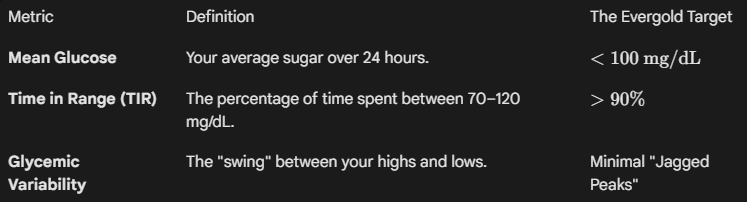
The Variability Trap: A person with a "perfect" $HbA1c$ of $5.4\%$ could still be at high risk for dementia if their blood sugar is constantly swinging from $70$ to $200$. It is the swing (oxidative stress) that damages the delicate capillaries in your brain and eyes.
4. Senior-Specific "Aha!" Moments
In our community, three patterns consistently emerge during the 30-day CGM experiment:
A. The "Dawn Phenomenon"
Many seniors see their glucose rise at 5:00 AM before they’ve even eaten. This is your body releasing cortisol and glucose to prepare you for the day. While natural, an excessive "Dawn Spike" can be a sign of liver insulin resistance or poor sleep quality.
B. The "Post-Prandial" Plummet
If you feel exhausted two hours after a high-carb meal, your CGM will show you why. Your body likely over-secreted insulin, causing a "crash" (Reactive Hypoglycemia). For a 70-year-old, this crash is a major contributor to "Senior Brain Fog."
C. The Sleep Connection
One of the most profound insights is seeing a glucose spike at 2:00 AM. This often happens after a glass of wine or a late-night snack. High glucose during sleep prevents the Glymphatic System from washing away "brain trash," increasing the risk of neurodegeneration.
5. How to Get a CGM in 2026
While still technically requiring a prescription for "medical use" in some regions, the landscape for "longevity use" has opened up.
Direct-to-Consumer Platforms: Services like Levels, Nutrisense, and Veri provide the hardware (sensors) and an overlay app that "scores" your food. They handle the physician consultation internally.
The "Longevity-Forward" Doctor: If you follow a Medicine 3.0 practitioner, simply ask. The cost out-of-pocket is typically $75–$150 per month.
Pharmacy Apps: In 2026, several over-the-counter versions (like the Dexcom Stelo) are available for non-diabetics, specifically designed for those of us wanting to optimize metabolic health.
6. Action Step: Your First "Buffering" Hack
If you’re waiting for your CGM to arrive, start this "Evergold" habit today: The Order of Operations.
Data shows that if you eat your vegetables first, then your protein/fat, and then your carbohydrates, you can reduce your glucose spike by up to 50% without changing a single ingredient.
Conclusion: From Data to Intuition
The goal of a 30-day CGM experiment isn't to become obsessed with numbers. It’s to "calibrate" your intuition.
After 30 days, you won't need the sensor to tell you that a late-night pasta dinner makes you feel sluggish the next morning—you’ll have seen the data. You’ll know exactly how many air-squats it takes to kill a "hidden spike." You are taking the "Black Box" of your aging metabolism and turning it into a transparent, manageable system.
That is the essence of being Evergold: Using the best of modern tech to ensure your Marginal Decade is defined by clarity, not "fog."
Contact
© 2026. All rights reserved.
DISCLAIMER
We love sharing information, but please remember we aren't doctors, lawyers, or financial advisors. Always check in with a professional before you start a new fitness routine, change your diet, or make big financial decisions. Your specific situation deserves expert attention.