
Cold Plunge for Seniors: Is it Safe for Your Heart? (Safety Guide)
To gain the benefits of the cold without the risks, we must understand the neurobiology of the Cold Shock Response and engineer a protocol that respects the maturing cardiovascular system.
Evergold Longevity
5/5/20265 min read
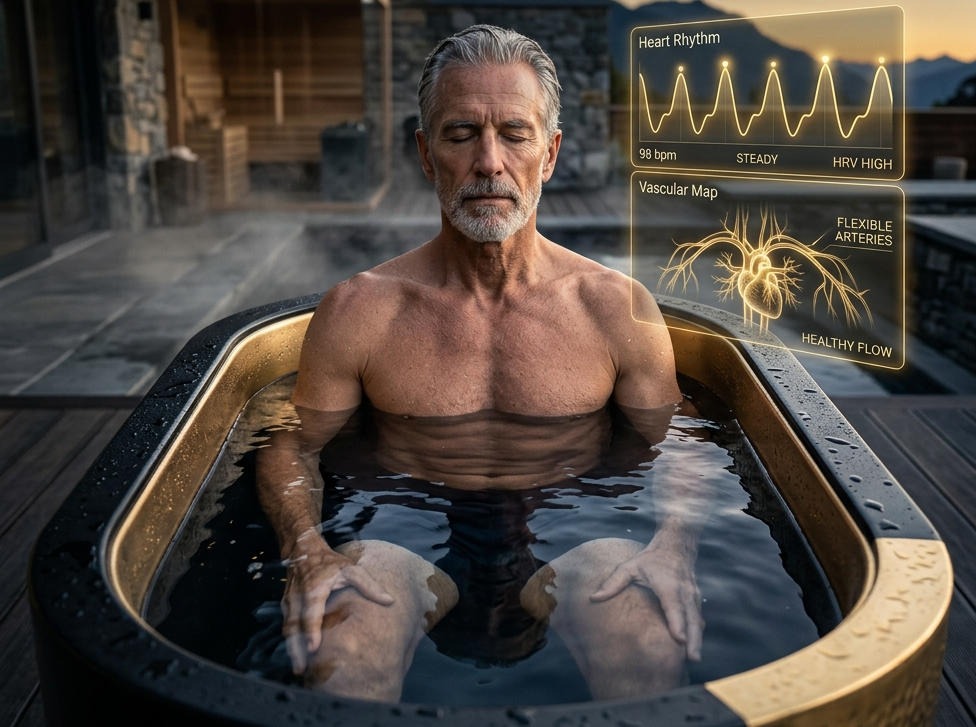
In the cultural zeitgeist of 2026, the cold plunge has evolved from an eccentric practice of Nordic tribes and elite commandos into a mainstream pillar of the longevity movement. We see the images everywhere: high-performance CEOs and "biohackers" submerged in chest-deep ice, claiming total physiological rebooting.
But for the Evergold senior—the individual over 60 who is prioritizing Healthspan over mere vanity—the question is more nuanced. Is the cold plunge a potent "hormetic" stressor that fortifies the heart, or is it a biological gamble that risks a cardiovascular event?
In the Medicine 2.0 era, the answer was a flat "no" for seniors. In the Medicine 3.0 era, the answer is: It depends on your calibration. To gain the benefits of the cold without the risks, we must understand the neurobiology of the Cold Shock Response and engineer a protocol that respects the maturing cardiovascular system.
1. The Physiology of the "Cold Shock": What Happens to the Heart?
The moment your skin hits water below 15°C (60°F), your body initiates a violent, coordinated survival response. This is not a "relaxation" technique; it is an acute sympathetic nervous system "storm."
The Vasoconstriction Spike
When you submerge, your peripheral blood vessels (in your arms and legs) constrict instantly. This is a survival mechanism designed to shunt warm blood toward your vital organs. However, this massive shift in blood volume significantly increases Peripheral Resistance. For a heart that may already be managing arterial stiffness or hypertension, this is a "Heavy Lift" event.
The Noradrenaline Surge
The cold triggers a massive release of Noradrenaline (norepinephrine) from the adrenal glands and the brain’s locus coeruleus. In 2026, we measure this as a 200-300% increase in circulating catecholamines. This surge is what provides the legendary "cold plunge high," but it also causes a rapid spike in heart rate and blood pressure.
2. The Risks: Atherosclerosis and the "Dive Reflex"
For the senior, the primary concern is the Interplay of Dual Reflexes. When your face hits cold water, the "Mammalian Dive Reflex" attempts to slow your heart down. Simultaneously, the "Cold Shock Response" (from the body immersion) is telling your heart to speed up.
This "Autonomic Conflict" can, in rare cases, trigger arrhythmias (irregular heartbeats) in individuals with underlying electrical issues. Furthermore, if you have significant Atherosclerosis (plaque buildup), the sudden spike in blood pressure could theoretically place undue stress on a vulnerable plaque.
The Evergold Verdict: Cold plunging is a high-yield intervention, but it is not an entry-level biohack. It requires a baseline of cardiovascular health confirmed by a modern CT Angiogram (Cleerly) or a high-fidelity stress test.
3. The Rewards: Why We Brave the Ice
If the risks are real, why do we do it? Because when managed correctly, the cold plunge is a Geroprotective Powerhouse.
I. The "Vascular Gym"
Regular, controlled cold exposure trains your blood vessels to constrict and dilate more efficiently. This improves Endothelial Function—the health of the inner lining of your arteries. For a 60-year-old, "flexible" arteries are the ultimate defense against stroke and heart failure.
II. Combatting "Inflammaging"
Chronic, low-grade inflammation is the "soil" in which almost all age-related diseases grow. Cold immersion has been shown to reduce C-Reactive Protein (CRP) and interleukin-6 levels. By "chilling" the systemic inflammatory fire, you are protecting your joints, your brain, and your heart.
III. Insulin Sensitivity and Brown Fat
Cold exposure activates Brown Adipose Tissue (BAT). Unlike regular white fat, brown fat is thermogenic—it burns calories to create heat. This improves blood glucose clearance and insulin sensitivity, providing a metabolic "buffer" against the standard American diet.
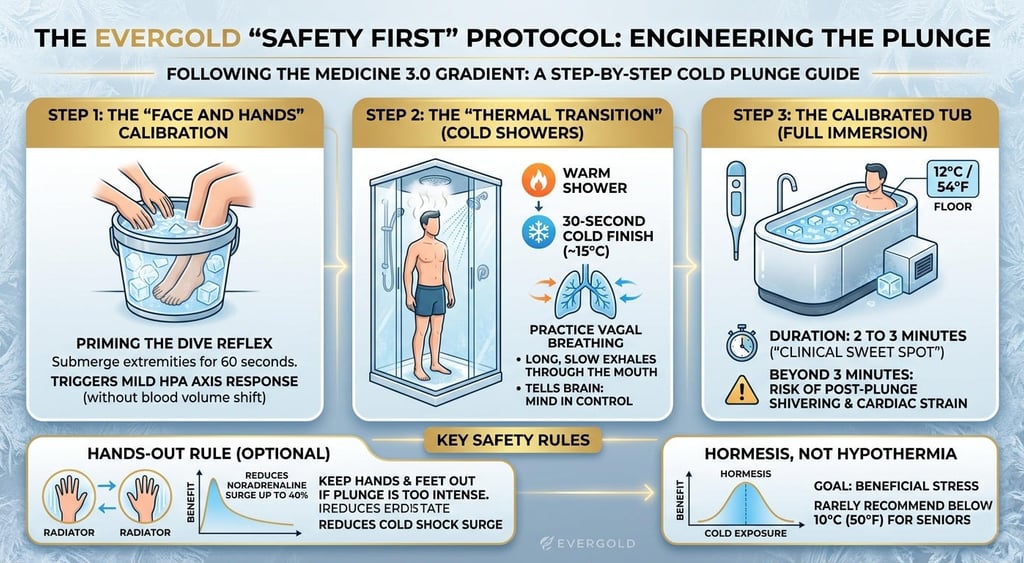
4. The Evergold "Safety First" Protocol: Engineering the Plunge
If you have cleared your cardiovascular audit, you do not simply jump into a tub of ice. You follow the Medicine 3.0 Gradient.
Step 1: The "Face and Hands" Calibration
Before your first full immersion, start with your extremities. Splashing your face with ice water or submerging your hands and feet for 60 seconds triggers a mild version of the dive reflex. This "primes" your HPA axis without the massive blood volume shift of a full-body plunge.
Step 2: The "Thermal Transition" (Cold Showers)
The 2026 gold standard for beginners is the 30-Second Finish. Perform your usual warm shower, but finish with 30 seconds of cold (approx. 15°C). This allows you to practice Vagal Breathing—long, slow exhales through the mouth—which tells your brain that while the body is in "danger," the mind is in control.
Step 3: The Calibrated Tub (The 12°C/54°F Floor)
For seniors, we rarely recommend plunging below 10°C (50°F). The goal is "Hormesis" (beneficial stress), not hypothermia.
Duration: 2 to 3 minutes is the clinical "sweet spot." Beyond 3 minutes, you risk a "Drop" in core temperature that can lead to post-plunge shivering and cardiac strain.
The Hands-Out Rule: If you find the plunge too intense, keep your hands and feet out of the water. These "radiators" account for a significant portion of the cold shock; keeping them dry reduces the noradrenaline surge by up to 40%.
5. Contraindications: When to Stay Dry
At Evergold, we believe in Empowered Risk, but we also believe in data. You should avoid full-body cold immersion if you have:
Uncontrolled Hypertension: If your resting blood pressure is over 140/90, the plunge spike is too risky.
Raynaud’s Disease: Extreme cold can cause severe vasospasms in the extremities.
Recent Cardiac Surgery: Your vascular system needs at least 6–12 months of stabilization before handling the cold shock.
Known Arrhythmias (AFib): The "Autonomic Conflict" can trigger a flare-up.
6. The 2026 Audit: Measuring Your Recovery
How do you know if the cold plunge is "building you up" or "breaking you down"? You look at your Autonomic Metrics.
HRV (Heart Rate Variability): If your HRV drops significantly the day after a plunge, your nervous system is struggling to recover. Reduce the duration or increase the temperature.
RHR (Resting Heart Rate): A successful cold protocol should lead to a lower resting heart rate over time as your Vagal Tone improves.
Sleep Quality: Many seniors report the best sleep of their lives after an afternoon plunge. If the plunge makes you "wired" at night, your noradrenaline clearance is too slow—move your sessions to the morning.
Conclusion: Sovereignty Over the Storm
The cold plunge is not a test of "toughness." It is a test of Biological Stewardship. In the Medicine 3.0 era, we don't fear the cold; we use it as a precision instrument to sharpen our vascular response and quiet the fires of inflammation.
If you respect the protocol, monitor your metrics, and clear your hardware with your longevity concierge, the cold plunge can be the most transformative tool in your kit. It is the path to a heart that is not just "beating," but resilient.
Stay Sharp. Stay Cold. Stay Evergold.
Contact
© 2026. All rights reserved.
DISCLAIMER
We love sharing information, but please remember we aren't doctors, lawyers, or financial advisors. Always check in with a professional before you start a new fitness routine, change your diet, or make big financial decisions. Your specific situation deserves expert attention.