
Cognitive Health: Using Nootropics to Stay Sharp in the Medicine 3.0 Era
The cognitive function is a dynamic asset—Neurological Capital—that must be aggressively managed, optimized, and defended.
Evergold Longevity
3/31/20265 min read
Transparency Note: We use affiliate links on this page. If you decide to buy something through these links, we may earn a small commission. This helps us keep the site running and provides you with free content. Thank you for the support!
In the traditional medical model (Medicine 2.0), brain health is often treated as a binary state: you are either "cognitively intact" or you have a "clinical diagnosis." This reactive approach waits for a significant decline—marked by memory loss or executive dysfunction—before initiating intervention. By the time symptoms are severe enough to warrant a prescription, the underlying neurological landscape has often suffered years of unaddressed "epigenetic noise" and structural attrition.
At EvergoldLongevity, we operate in the paradigm of Medicine 3.0. We view cognitive function as a dynamic asset—Neurological Capital—that must be aggressively managed, optimized, and defended. Central to this strategy is the use of Nootropics: a class of compounds designed to enhance cognitive function, facilitate neurogenesis, and protect the brain from the oxidative stress of aging.
1. The Biological Reality of the Aging Brain
To understand why nootropics are necessary, we must first understand what they are fighting. Aging in the brain is characterized by three primary drivers:
Mitochondrial Decay: Just like the muscles, the brain's "power plants" become less efficient, leading to reduced ATP production and mental fatigue.
Synaptic Pruning and Loss: The connections between neurons become less dense, slowing down processing speed and memory recall.
Chronic Neuroinflammation: Often called "Inflammaging," this is the low-grade, systemic inflammation that damages the blood-brain barrier (BBB) and impairs cellular repair.
2. What are Nootropics? (Beyond the "Limitless" Pill)
The term "nootropic" was coined in 1972 by Dr. Corneliu Giurgea. To be classified as a true nootropic, a substance must meet specific criteria: it must enhance learning and memory, protect the brain from physical or chemical injuries, and—crucially—it must be non-toxic and free of the heavy side effects associated with psychotropic drugs.
In the Medicine 3.0 era, we categorize nootropics into two distinct groups: Foundationals (nutrients the brain needs to function) and Enhancers (compounds that trigger specific adaptive responses).
3. The Evergold Foundational Stack: Building the Hardware
Before reaching for exotic enhancers, one must ensure the brain has the raw materials required for structural integrity.
I. The Phospholipid Anchor: Phosphatidylserine (PS)
PS is a fatty substance that covers and protects the cells in your brain and carries messages between them. It is essential for maintaining the fluidity of the cell membranes.
The Longevity Edge: Clinical studies show that PS supplementation can effectively "reset" the biological clock of the brain by up to 12 years in terms of memory performance.
II. The Acetylcholine Precursor: Citicoline (CDP-Choline)
Acetylcholine is the primary neurotransmitter for learning and focus. As we age, our natural production declines.
The Longevity Edge: Unlike standard choline, Citicoline also increases the density of dopamine receptors and provides the brain with Uridine, which is critical for repairing neural membranes.
4. The Enhancers: Triggering Neurogenesis and Resilience
Once the hardware is supported, we use specific nootropics to "upgrade the software" and trigger Neuroplasticity.
I. The "Brain-Derived Neurotrophic Factor" (BDNF) Catalyst: Lion’s Mane
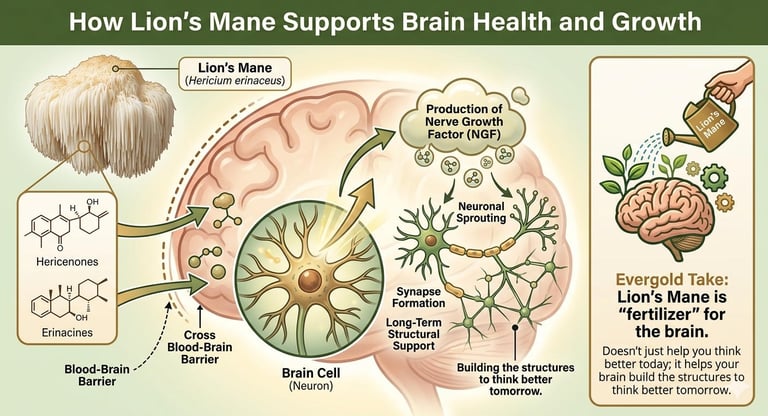
Lion’s Mane (Hericium erinaceus) is a medicinal mushroom that contains two unique compounds: hericenones and erinacines.
The Mechanism: These compounds cross the blood-brain barrier and stimulate the production of Nerve Growth Factor (NGF).
The Evergold Take: We view Lion’s Mane as "fertilizer" for the brain. It doesn't just help you think better today; it helps your brain build the structures to think better tomorrow.
II. The Memory Architect: Bacopa Monnieri
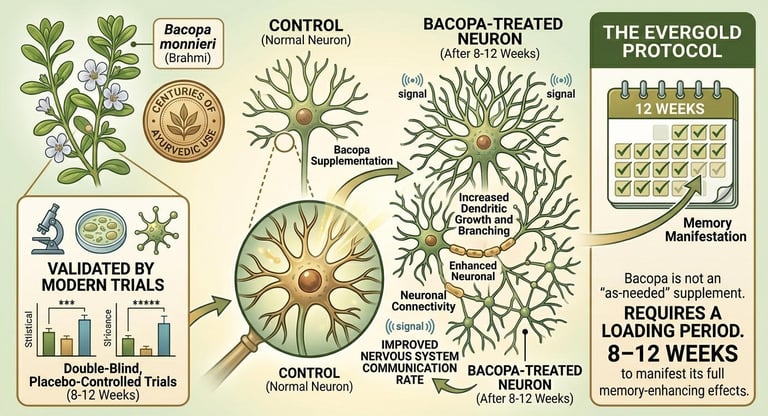
An Ayurvedic herb with centuries of use, Bacopa has been validated by modern double-blind, placebo-controlled trials.
The Mechanism: It enhances the rate at which the nervous system can communicate by increasing the growth of dendrites—the finger-like projections on neurons.
The Protocol: Bacopa is not an "as-needed" supplement. It requires a loading period of 8–12 weeks to manifest its full memory-enhancing effects.
III. The Stress Adaptogen: Rhodiola Rosea
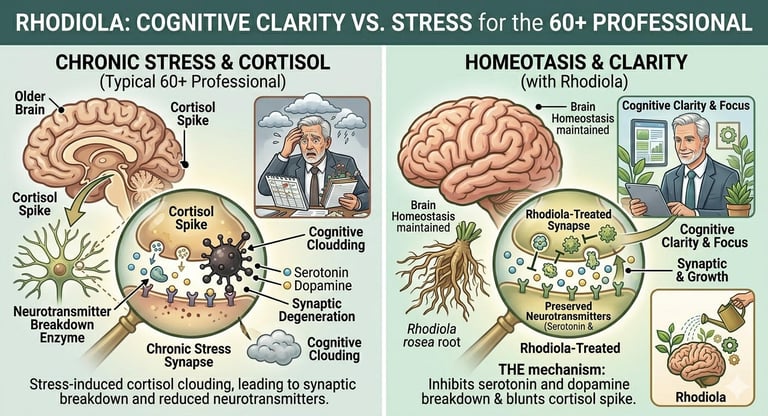
For the 60+ professional, cognitive clarity is often clouded by cortisol and stress. Rhodiola helps the brain maintain homeostasis.
The Mechanism: It inhibits the breakdown of serotonin and dopamine while blunting the "spike" of cortisol during stressful events.
5. The Glymphatic System: The Brain’s Essential "Night Shift"
No nootropic stack can overcome a failure of the Glymphatic System—the brain's waste-clearance pathway. During sleep, the space between your brain cells increases, allowing cerebrospinal fluid to "wash away" metabolic waste, including amyloid-beta plaques.
At EvergoldLongevity, we emphasize that nootropics like L-Theanine (found in green tea) are most valuable when used to improve Sleep Architecture. By increasing alpha-wave activity in the brain, L-Theanine promotes a state of "calm alertness" that facilitates deeper, more restorative sleep, allowing your nootropic stack to work on a clean, well-rested canvas.
6. The "Golden Hour" of Focus: Caffeine and L-Theanine
The most widely used nootropic in the world is caffeine. However, in Medicine 3.0, we use it with precision. The "Evergold Focus Protocol" pairs caffeine with L-Theanine in a 1:2 ratio.
The Benefit: L-Theanine smooths out the "edges" of caffeine, eliminating jitters and the subsequent crash, while providing a synergistic boost to attention and reaction time.
7. Safety, Purity, and the "Bio-Individual" Approach
The supplement industry is notoriously under-regulated. For the Evergold Athlete, Purity is Performance. * Third-Party Testing: Only use brands that provide a Certificate of Analysis (CoA) for every batch, ensuring the absence of heavy metals and the presence of active ingredients.
The Cycling Strategy: The brain is highly adaptive. To prevent down-regulation of receptors, we recommend a "5-on, 2-off" or "3-weeks-on, 1-week-off" cycling strategy for most enhancers.
8. The Evergold Cognitive Protocol: Tiers of Optimization
Tier 1: The Foundation (Daily)
Citicoline: 250-500 mg for neurotransmitter support.
Omega-3 (EPA/DHA): 2,000 mg+ for membrane integrity.
L-Theanine: 200 mg (pm) for sleep architecture.
Tier 2: The Resilience Builder (Cycles)
Lion’s Mane: 500-1,000 mg (dual-extract) for NGF stimulation.
Bacopa Monnieri: 300 mg (standardized to 55% bacosides) for memory density.
Tier 3: The High-Performance Executive (As Needed)
Rhodiola Rosea: 200 mg for acute stress management.
Caffeine + L-Theanine Stack: For deep work sessions.
Conclusion: Investing in Your Neurological Future
Your brain is the most complex structure in the known universe, and its maintenance is your most important job in retirement. Nootropics are not "magic pills," but they are essential tools in the Medicine 3.0 toolkit. By combining these compounds with Zone 2 exercise, deep sleep, and a low-inflammation diet, you are doing more than just "staying sharp." You are aggressively defending your identity, your memories, and your future.
Stay Sharp. Stay Focused. Stay Evergold.
Contact
© 2026. All rights reserved.
DISCLAIMER
We love sharing information, but please remember we aren't doctors, lawyers, or financial advisors. Always check in with a professional before you start a new fitness routine, change your diet, or make big financial decisions. Your specific situation deserves expert attention.