
Reviewing the Best Binge-Watching for Seniors: Safety & Posture
In the current golden age of television, the term "binge-watching" has moved from a niche hobby to a primary form of entertainment. However, we must look at binge-watching for seniors through a clinical lens.
Evergold Longevity
1/18/20265 min read
In the current golden age of television, the term "binge-watching" has moved from a niche hobby to a primary form of entertainment. For those in their 60s and beyond, streaming services like Netflix, HBO, and Amazon Prime offer a gateway to storytelling that is more immersive and accessible than ever before. However, as we prioritize our "Marginal Decade"—that final period of life where we aim to maintain peak physical and cognitive function—we must look at binge-watching through a clinical lens.
Is binge-watching inherently "bad"? Not necessarily. But for a body in its 60s, a four-hour sitting marathon is not just a leisure activity; it is a physiological event. From musculoskeletal strain to vascular risks like DVT, the cost of "just one more episode" can be high if not managed with precision.
In this guide, we provide the Evergold Blueprint for Safe Streaming, focusing on the ergonomics, biology, and biohacking protocols that allow you to enjoy world-class entertainment without sacrificing your longevity.
1. The Anatomy of the "Couch Potato": Why Posture is Longevity
When you sit for extended periods, your body enters a state of "passive suspension." In your 20s, the spine is resilient enough to bounce back from a night on a saggy sofa. In your 60s, the discs in your vertebrae have less fluid, and your supporting musculature is more prone to fatigue.
The "Forward Head" Trap
The most common postural mistake during binge-watching is Forward Head Posture (FHP). As we get engrossed in a plot, our chin naturally drifts toward the screen. For every inch your head moves forward, it adds an additional 10 pounds of pressure to your cervical spine. This leads to "Tech Neck," which can cause chronic tension headaches, reduced lung capacity, and even balance issues.
The Evergold Ergonomic Setup:
The 90-90-90 Rule: Your hips, knees, and ankles should all be at 90-degree angles. If your feet are dangling, use a firm footrest. This prevents pressure on the back of your thighs, which can impede circulation.
Lumbar Integrity: Use a chair with dedicated lumbar support. If you are using a standard sofa, place a firm "lumbar roll" or a rolled-up towel in the small of your back to maintain the natural inward curve of the spine.
Screen Height: The top third of your TV screen should be at eye level. If you find yourself looking up or down, you are straining the delicate muscles of the neck.
2. The Vascular Risk: Deep Vein Thrombosis (DVT)
One of the most serious risks associated with prolonged sitting—whether on a long-haul flight or a long-haul binge—is Deep Vein Thrombosis. This occurs when a blood clot forms in the deep veins, usually in the legs. For seniors, the risk is amplified by age-related changes in vein elasticity and blood viscosity.
A 2018 study in the Journal of Thrombosis and Thrombolysis found that those who "frequently" watched TV had a 70% higher risk of DVT than those who seldom watched.
Biohacking Your Circulation:
The 30-Minute Reset: Set a timer on your phone or smartwatch (like an Apple Watch or Oura Ring) to vibrate every 30 minutes. When it goes off, stand up for exactly 60 seconds.
Seated Calf Raises: While watching, perform "pumping" motions with your feet. Lifting your heels while keeping your toes on the floor engages the calf muscles, which act as a "second heart" to pump blood back up to your torso.
Hydration is Key: Dehydration thickens the blood. Keep a 32oz glass of water nearby. Not only does this keep you hydrated, but the natural consequence—needing to use the bathroom—forces a movement break.
3. Protecting the "Windows to the Soul": Eye Health and Blue Light
Digital eye strain is more than just an annoyance; for seniors, it can exacerbate existing conditions like dry eye or macular degeneration.
The 20-20-20 Rule
To prevent "accommodation fatigue" (where the eye muscles get stuck in a near-focus state), follow the 20-20-20 Rule: Every 20 minutes, look at something 20 feet away for at least 20 seconds. This allows the ciliary muscles in the eyes to relax.
Circadian Rhythm Disruption
Binge-watching late into the night exposes you to high amounts of Blue Light. This light spectrum signals to your brain that it is daytime, suppressing the production of melatonin. For those over 60, who often struggle with sleep architecture already, this can lead to fragmented sleep and "social jetlag."
The Solution:
Blue Light Glasses: Invest in high-quality amber-tinted glasses for evening viewing.
Screen Calibration: Most modern TVs have a "Warm" or "Eye Comfort" mode. Enable this after 7:00 PM.
The "Hard Cutoff": Stop all streaming at least 60 minutes before your intended sleep time to allow your brain to "downshift."
4. Active Bingeing: Turning the Couch into a Gym
Who says you have to sit still? One of the best ways to mitigate the metabolic damage of sedentary time is to integrate light movement into the show itself.
The "Commercial Break Protocol"
If you are watching traditional TV, the commercials are your gym time. If you are on a streaming service, pause between episodes for a 3-Minute Mobility Flow:
Chair Squats: Stand up and sit down 10 times without using your hands. This builds the functional strength needed for long-term independence.
Doorway Chest Stretch: Standing in a doorway, place your arms on the frame and lean forward. This counteracts the "hunching" caused by forward-leaning posture.
Wall Slides: Stand with your back against a wall and slide your arms up and down like "snow angels." This resets your scapular (shoulder blade) position.
Peripheral Tools:
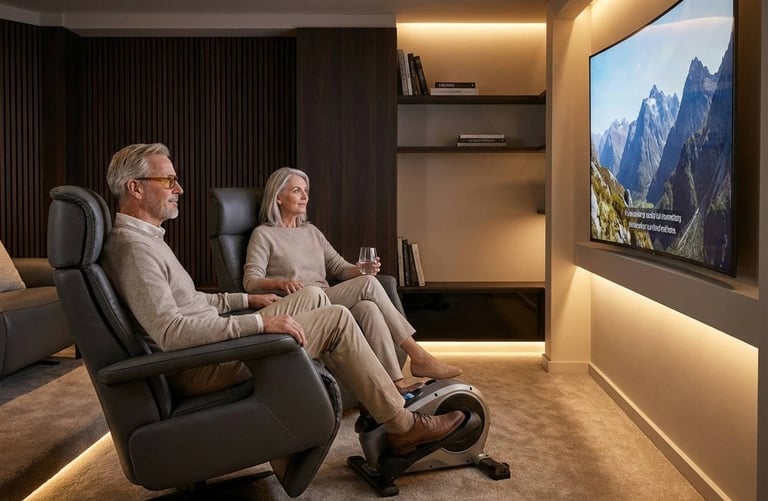
Consider using a portable under-desk pedal exerciser while you watch. This low-intensity Zone 1 activity keeps your metabolism "simmering" and prevents the drop in lipoprotein lipase (the enzyme that breaks down fat) that occurs during total stillness.
5. The Cognitive and Social Component
Longevity isn't just about the body; it's about the brain and the heart. Passive TV consumption can be isolating, which is a known driver of cognitive decline in seniors.
Social Streaming
Whenever possible, make binge-watching a social event. Use features like "Teleparty" to watch with family in other cities, or better yet, watch with a partner or friend in the room. Discussing the plot, predicting twists, and analyzing character motives turns a passive activity into an active cognitive challenge.
Content Selection
Research suggests that watching high-quality, complex dramas or educational documentaries stimulates different neural pathways than "low-effort" reality TV. Choose shows that challenge your worldview or teach you a new skill.
6. Nutrition: Avoiding the "Mindless Eating" Trap
The brain’s "satiety signals" are weakened when we are distracted by a screen. This is why a family-sized bag of popcorn can disappear before the first act is over.
The Evergold Nutrition Hack:
Pre-Portioning: Never eat directly from a bag. Use a small bowl to control portions.
The "Crunch Factor": If you need to "fidget-eat," opt for high-fiber, low-calorie options like cucumber slices with tajin or lightly salted edamame.
Tea over Alcohol: While a glass of wine might seem like the perfect companion for a mystery thriller, alcohol further disrupts sleep and acts as a muscle relaxant, making you more likely to slump into poor posture.
Conclusion: The right TV posture for elderly
In your 60s, every hour spent in front of the screen is an opportunity to either deplete or defend your health reserves. By applying the Evergold Posture and Safety Protocol, you transform binge-watching from a "guilty pleasure" into a sustainable part of a high-performance lifestyle.
Remember: the goal isn't to stop watching. The goal is to ensure that you are still physically capable and mentally sharp enough to watch the series finale of your favorite show twenty years from now.
Next Steps: Check your TV height tonight. If you have to tilt your chin up, it’s time to lower the stand. Your neck will thank you in the morning.
Contact
© 2026. All rights reserved.
DISCLAIMER
We love sharing information, but please remember we aren't doctors, lawyers, or financial advisors. Always check in with a professional before you start a new fitness routine, change your diet, or make big financial decisions. Your specific situation deserves expert attention.